Chapter 3

The Way of Action

Why Action Cannot Be Escaped

Arjuna's objection

There is confusion in Arjuna's voice now, not grief. "Say one thing clearly," he says. "If you think understanding is higher than action, then why are you driving me into this terrible work? If knowledge is higher, show me one path — the one that actually leads to what is good."

No one is actionless

Krishna's answer is direct. Two long-established paths are spoken of, he says — one built around knowledge, one around action — but neither one grants a licence to do nothing. No one can stay actionless even for a moment; nature keeps everyone in motion whether they will it or not.

"To sit still on the outside," he adds, "while the mind keeps chasing after its objects — that is not renunciation. That is pretence, and worse than honest work."

Action as offering

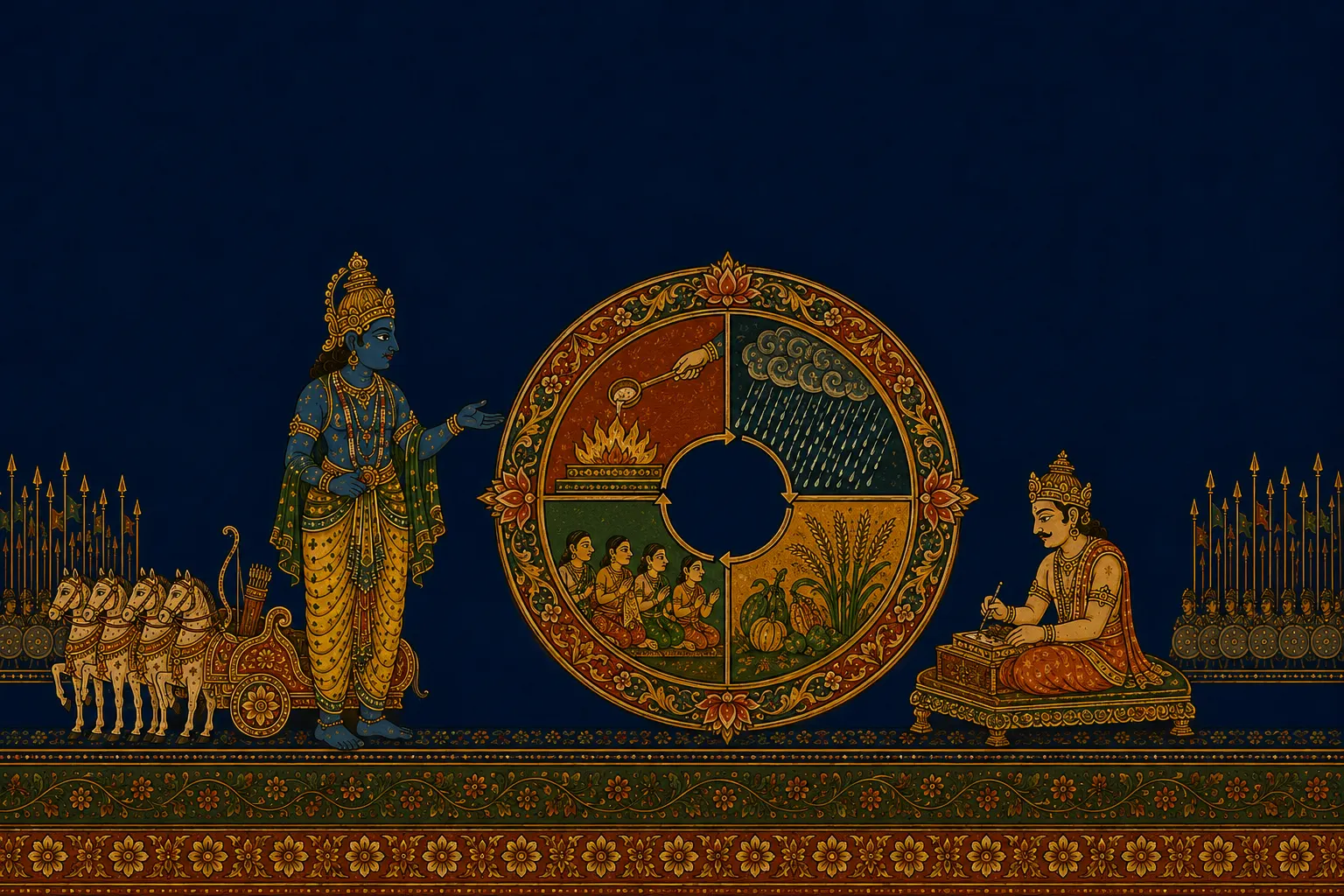
Action performed as an offering — *yajna* — does not bind. Krishna takes the old idea of sacrifice and widens it into an entire principle for living: sacrifice draws down the rain, the rain raises food, food sustains beings, and beings owe sacrifice back in return — a cycle no one can break alone.

"The one who takes from this cycle and gives nothing back," Krishna says, "is a thief." But the one who acts in the spirit of sacrifice, without trying to possess the result, finds their bonds loosening, little by little.

Why the wise still work

He offers two examples. King Janaka and others like him reached perfection not by stepping back from action, but by staying fully immersed in it. And then Krishna points to himself. "There is nothing in the three worlds I need to gain, nothing I lack — and still I work."

"If I stopped," he says, "people would take me as the model and stop too, and the worlds would fall apart — I myself would become the root of their confusion." He calls the purpose of such action *loka-sangraha* — holding the world together — and says the realised person keeps working for that alone, never for themselves.

The enemy within

Arjuna asks a sharp, searching question: "What is it that drives a person to do wrong — almost against their own will?"

Krishna names it — desire, and its neighbour anger, both born of the quality of *rajas*. "It covers over knowledge," he says, "the way smoke covers fire, the way dust covers a mirror, the way a womb covers a child."

Its footholds, he says, are the senses, the mind and the intellect; from there it clouds judgement. "Bring those under control," he tells Arjuna, "and this very thing can be struck down."

Note: *Loka-sangraha* becomes, in Tilak's reading, the Gita's bridge from spiritual life to public duty. "Nature does everything, so I bear no responsibility" is not the chapter's conclusion — Krishna's very next move is to command disciplined action and restraint. How verse 3.35, "your own duty done imperfectly is better than another's done well, and para-dharma is fraught with danger," relates to later birth-based caste is a long-running interpretive question the verse itself does not settle.

Source: Mahabharata — Bhishma Parva, The Way of Action

Now — how much stayed with you?

Who said it?

"If you think understanding is higher than action, why are you driving me into this terrible work?" — who says this?

  • Krishna
  • Sanjaya
  • Arjuna
  • Dhritarashtra
Read the whole story — Arjuna's objection

In Chapter 2 Krishna spoke of both knowledge and action, and to Arjuna it sounded like a tangle of praise for both.

He demands: say one thing clearly — one path, so that I can follow it and reach what is good.

Krishna answers without stepping off the battlefield: no one can stay actionless even for a moment.

Fact

What does Krishna call sitting still on the outside while the mind runs after its objects?

  • True renunciation
  • Pretence
  • The highest yoga
  • The first step of meditation
Read the whole story — No one is actionless

Krishna says nature keeps everyone in motion whether they will it or not — no one can stay actionless even for a moment.

So the real question is not whether to give up action but how to do it.

Outward stillness with an inward chase is not renunciation; it is pretence.

What happened?

What does Krishna do with the old idea of sacrifice (*yajna*)?

  • He rejects it entirely
  • He keeps it limited to the Vedic fire ritual
  • He makes it the duty of kings only
  • He widens it into a principle for living
Read the whole story — Action as offering

Action performed as an offering does not bind.

The one who takes from that cycle and gives nothing back to it lives, Krishna says, as a thief.

Action done as a return into the cycle, without grasping, leaves the doer free.

Who am I?

There is nothing in the three worlds I need or lack, and still I work — so that people do not take inaction as the model and the worlds fall into ruin. Who am I?

  • King Janaka
  • Arjuna
  • Krishna himself
  • The sun-god Vivasvan
Read the whole story — Why the wise still work

Krishna offers two examples: King Janaka, who reached perfection while fully engaged in action; and himself, who needs nothing yet works.

If he stopped, he says, people would take that as the model and stop too, and the worlds would fall into ruin.

He calls the aim of such action *loka-sangraha* — holding the world together.

Fact

What is Arjuna's sharp psychological question, and how does Krishna answer it?

  • Question: what drives a person to do wrong, almost against their own will? Answer: desire
  • Question: what is the self? Answer: it is deathless
  • Question: what happens after death? Answer: two paths
  • Question: what is action? Answer: an offering
Read the whole story — The enemy within

Desire covers over a person's knowledge the way smoke covers fire, or dust a mirror, or the womb a child.

Its footholds are the senses, the mind and the intellect; from there it clouds judgement.

Bring those under control, Krishna tells Arjuna, and the thing itself can be struck down.

Riddle

I am a word that means "holding the world together." Tilak made me the bridge from spiritual life to public duty. Which word am I?

  • *svadharma*
  • *nishkama karma*
  • *yajna*
  • *loka-sangraha*
Read the whole story — One word, one bridge

Krishna says the realised person keeps acting for *loka-sangraha*, not for their own sake.

In Tilak's reading this word turns the Gita away from private liberation and toward duty to society.

"Nature does everything, so I bear no responsibility" is not the chapter's conclusion — Krishna's very next move is to command disciplined action.

Why is that?

Why should the wise person, who has nothing to gain, keep acting, according to Krishna?

  • So that they attain liberation
  • So that people do not copy them into inaction and the worlds fall into confusion
  • So that they avoid sin
  • So that they keep their senses under control
Read the whole story — The weight of the example

Krishna says people tend to follow the conduct set by leading persons.

The actions of people in positions of influence become examples for others.

He puts the same argument on himself: if he stopped, the world would stop.

The texts disagree

What does verse 3.35 — "your own duty done imperfectly is better than another's done well, and para-dharma is fraught with danger" — mean?

  • All agree it means everyone must stay in their birth occupation forever
  • The verse speaks in the immediate framework of *svadharma*; how it relates to later birth-based caste is a long-running interpretive question the verse itself does not settle
  • It is Krishna's clearest caste-system statement, on which there is no disagreement
  • It means that doing another's work is a sin
Read the whole story — A verse that does not settle itself

3.35 contrasts *svadharma* with *para-dharma*, and that same line returns almost verbatim at 18.47.

Verse 4.13 itself uses the language of a "division of guna and karma"; how that connects to birth, social inheritance and later caste is deeply disputed among interpreters.

How this connects to the modern caste system is disputed among scholars; this account does not turn one resolution into "what the Gita says."

Put it in order

In what order does the argument move in Chapter 3?

  • The enemy within → sacrifice → no one is actionless → Arjuna's objection
  • Sacrifice → Arjuna's objection → the enemy within → no one is actionless
  • No one is actionless → the enemy within → sacrifice → Janaka's example
  • Arjuna's objection → no one can stay actionless → action as an offering → why the wise still work → the enemy within (desire and anger)
Read the whole story — From objection to answer

The chapter opens on a direct question and closes on a direct answer.

In between, Krishna uses sacrifice, *loka-sangraha* and his own example to show that action is not bondage if it is done in the right spirit.

Arjuna's closing question — what compels a person — seeds the guna-analysis of the later chapters.

Later tradition

"If nature does everything, then a person bears no responsibility" — is this the conclusion of Chapter 3?

  • No
  • Yes, Krishna says exactly that
  • Yes, and so Arjuna should not fight
  • No
Read the whole story — Half a sentence, a wrong conclusion

Krishna says the gunas act on the gunas, and the deluded ego thinks "I am the doer."

But he immediately commands control of desire and anger — so responsibility remains.

This is the Gita's repeated move: keeping a metaphysical statement from becoming an excuse to drop action.