Chapter 5

The Renunciation of Action

The Lotus Leaf

Which is better?

Arjuna returns to the same knot. "You praise the renunciation of action," he says, "and in the next breath you praise disciplined action. These pull in opposite directions — tell me plainly which one is better."

The true renouncer

Krishna answers by redefining the word. "Both paths lead to the same place," he says, "but of the two, karma yoga is superior — renunciation without yoga is hard, and for most people, yoga is far more workable."

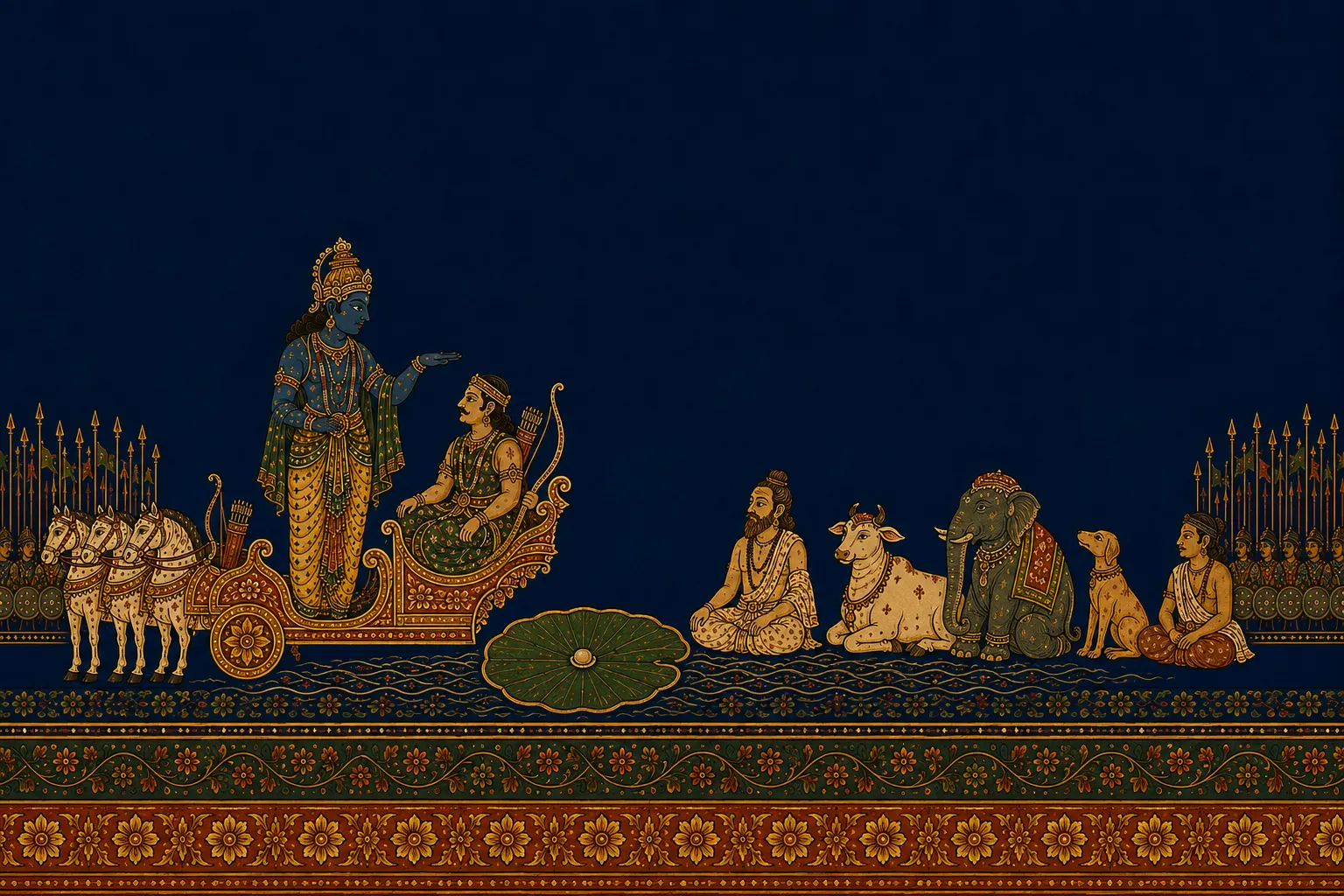
The real renouncer, he goes on, is not the one who has stopped working — it is the one who has stopped hating and stopped craving, who is free of the pairs of opposites and acts without being governed by the outcome. Such a person acts and remains unstained, exactly the way a lotus leaf rests on water and the water never clings to it.

Not the doer

The disciplined person learns not to claim every bodily and sensory act as "I am doing this" — seeing, hearing, touching, eating, breathing, sleeping, all simply occur as the senses meet their objects, nothing more.

Handing every action over to Brahman, releasing any claim on it, they remain untouched by wrongdoing — because what binds a person, in this chapter's terms, is not the action itself but the ignorance that keeps insisting, "I am the doer."

The equal eye

Then comes one of the Gita's starkest lines. "The wise," Krishna says, "look with the very same eye on a learned and gentle brahmin, on a cow, an elephant, a dog, and an outcaste who eats the flesh of dogs."

The distinctions that rank human beings, that separate humans from animals — none of them reach the height from which the wise are looking. Those whose minds have settled into that evenness, he says, have already conquered the world of birth and death while still alive.

Peace within

Pleasures born of the senses touching their objects have a beginning and an end, and in the end are nothing but wombs of pain. The one who can withstand the pull of desire and anger while still living in the body — that is the one truly joined, truly at peace.

That peace rises from within and depends on nothing outside. Knowing Krishna as the final enjoyer of every sacrifice, the lord of all worlds, the friend of every being — such a person comes, at last, to rest.

Note: Advaita can push the "equal vision" of verse 5.18 toward the ultimate unreality of distinctions; Ramanuja and Madhva read it as right spiritual regard within a world where the differences remain real. The chapter closes not on an impersonal absolute but on a direct, personal statement about Krishna — the Gita is openly theistic well before Chapter 7.

Source: Mahabharata — Bhishma Parva, The Renunciation of Action

Now — how much stayed with you?

Who said it?

"You praise the renunciation of action, and in the next breath you praise disciplined action — tell me plainly which one is better" — who says this?

  • Krishna
  • Sanjaya
  • Bhishma
  • Arjuna
Read the whole story — Which is better?

In Chapter 4 Krishna praised both the renunciation of action and disciplined action, and to Arjuna they seemed to pull in opposite directions.

Chapter 5 opens on that direct question.

Krishna's answer is to redefine the word.

Fact

Which of the two paths does Krishna call superior?

  • The full renunciation of action
  • Solitary meditation
  • The discipline of action (karma yoga)
  • The vision of the universal form
Read the whole story — The true renouncer

Krishna says the real renouncer is not the one who has stopped working.

It is the one who has stopped hating and stopped craving, who is free of the pairs of opposites and acts without being governed by the outcome.

Such a person acts and remains unstained, the way a lotus leaf rests on water.

What happened?

By what image does Krishna describe how the one who acts stays unstained?

  • Like a lotus leaf resting on water, so that the water does not cling to it
  • Like dust on a mirror
  • Like a lamp in a windless place
  • Like gems on a thread
Read the whole story — Not the doer

The disciplined person does not claim every bodily and sensory process as "I am doing this."

Handing every action over to Brahman and letting go of any claim on it, they are not touched by wrongdoing.

Because what binds a person, in this chapter's terms, is not action but the ignorance that says "I am the doer."

Fact

In verse 5.18, on whom does Krishna say the wise look with the same eye?

  • On all human beings only
  • On all the gods only
  • On friend and enemy only
  • On a learned and gentle brahmin, a cow, an elephant, a dog, and an outcaste who eats the flesh of dogs
Read the whole story — The equal eye

This is one of the Gita's starkest lines — it deliberately crosses an elite human, animals and a socially marginalised person.

The distinctions that rank human beings do not reach the level the wise are seeing at.

Those whose minds rest in that evenness have already overcome the world of birth and death while still alive.

Who am I?

I am the enjoyer of every sacrifice, the lord of the worlds, and the friend of all beings — and this chapter closes not on an impersonal absolute but on me. Who am I?

  • Brahman, in its impersonal form
  • Krishna
  • Arjuna
  • The sun-god Vivasvan
Read the whole story — Peace within

Pleasures that come from the contact of the senses with their objects have a beginning and an end, and are, in the end, wombs of pain.

The person who can withstand the push of desire and anger while still in the body is the one who is truly joined, and that happiness is inward.

The Gita is openly theistic well before Chapter 7 — verse 5.29 is the proof.

Riddle

Two paths were put before me, and I was asked which is better. I said both lead to the highest good, but one is superior to the other. Which chapter am I?

  • Chapter 2
  • Chapter 5
  • Chapter 12
  • Chapter 18
Read the whole story — One knot, again and again

Arjuna asks nearly the same question three times — in Chapters 3, 5 and 12 — and each time Krishna answers a little differently.

Chapter 5's answer is explicit: both lead to the highest good, but Krishna says karma yoga is superior.

And true renunciation is not stopping work — it is stopping the hating and the craving.

Why is that?

Why is it a mistake to call the Gita "impersonal until Chapter 7"?

  • Because the Gita has no impersonal language at all
  • Because Chapter 5 is the yoga of devotion
  • Because Arjuna had already asked for the personal form
  • Because verse 5.29 already names Krishna the enjoyer of every sacrifice, the lord of the worlds and the friend of all beings
Read the whole story — Theism, already

It is commonly said that the Gita stays "impersonal" until Chapter 7 and then turns theistic.

But in 5.29 Krishna names himself the enjoyer of sacrifice, the lord of the worlds and the friend of beings.

So the chapter ends not on an abstract conclusion but on a personal one.

The texts disagree

How do the schools read the "equal vision" of verse 5.18?

  • Advaita can push it toward the ultimate unreality of distinctions; Ramanuja and Madhva read it as right spiritual regard within a world where the differences remain real
  • All agree that all distinctions are literally unreal
  • All agree the distinctions are real and the vision is only humility
  • The verse applies only to animals, not humans
Read the whole story — One verse, three readings

For Advaita, the equal vision points toward the distinctions that rank being not being ultimately real.

For Ramanuja and Madhva, the differences remain real — the seeing is corrected, the world is not.

This account does not say which is right; it simply notes that this is exactly where the three great Vedanta traditions part.

Put it in order

In what order does Chapter 5's teaching move?

  • The equal vision → Arjuna's question → the lotus leaf → the statement about Krishna
  • The lotus leaf → the statement about Krishna → Arjuna's question → the equal vision
  • Arjuna's "which is better" question → the true renouncer and the lotus leaf → "I am not the doer" → the equal vision (brahmin, cow, outcaste) → peace within and the statement about Krishna
  • The statement about Krishna → the equal vision → Arjuna's question → the lotus leaf
Read the whole story — Redefining a word

The chapter opens on a question and answers it by inverting it — the renouncer is the one who has dropped hatred, not work.

In between: the lotus leaf, "I am not the doer," and the stark line of the equal vision.

It ends on inner peace and on Krishna, and the breath-and-gaze regulation of 5.27–28 seeds the meditation of the next chapter.

Later tradition

"The Gita is purely impersonal up to Chapter 7" — is this right?

  • Yes, Krishna does not name himself before Chapter 7
  • No
  • Yes, 5.29 is a later inserted verse
  • No
Read the whole story — Both registers, from the start

The Gita has both impersonal and personal language, and it does not sort them into separate chapters.

5.29 is the clearest early example — a personal statement well before Chapter 7.

So the "impersonal first, personal later" split does not sit well on the text.