
Chapter 13
The Field and Its Knower
What Counts as Knowledge
The field and the knower
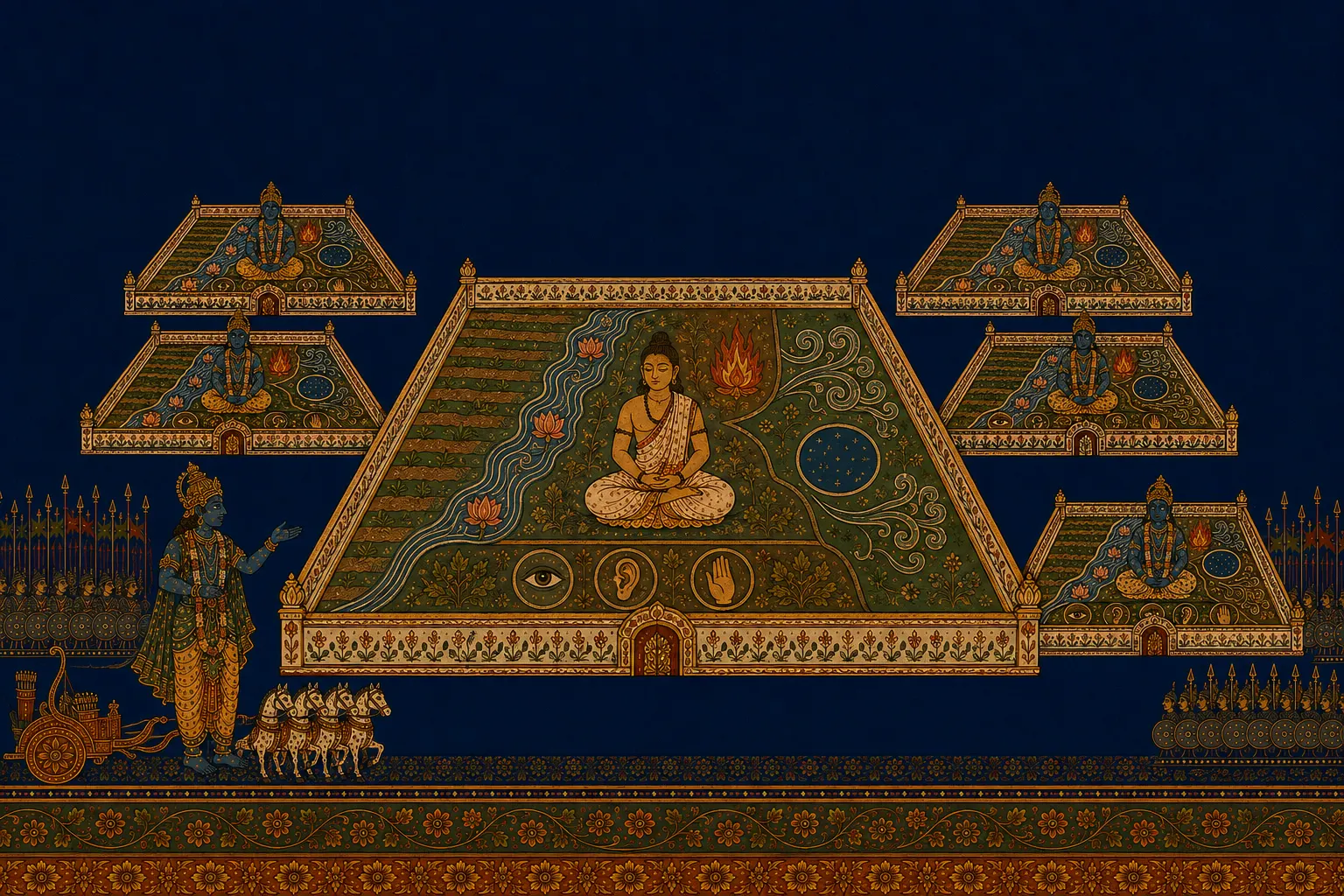
"This body," Krishna says, "is called the 'field,' and the one aware of it is the 'knower of the field.'" Then he adds a claim later commentators would argue over for centuries: "I myself am the knower in every field — in all bodies, at once."
The chapter then lists what the "field" is made of — the elements, the ego-sense, intellect, the unmanifest, the ten senses and the mind, the objects of the senses, and desire, aversion, pleasure, pain, the body-complex, awareness, and the will that holds a person together.
What "knowledge" means
Krishna gives a list that is not what a reader expects under that heading: humility, absence of pretence, non-violence, patience, honesty, service to a teacher, purity, steadiness, self-control, detachment from sense-objects, absence of ego.
He goes on: keeping in view the suffering in birth, age, sickness and death; not clinging to child, wife and home; evenness of mind in what is wanted and unwanted; unwavering devotion; a liking for solitude; steadiness in self-knowledge. "All of this," he says, "is knowledge — anything opposed to it is ignorance."
What is to be known
The object of that knowledge is a beginningless supreme reality the verses can only describe by paradox — inside all beings and outside them, unmoving and yet moving, far away and very near.
It is undivided, yet seems to be divided up among things; it is the light of all lights, said to be beyond darkness; it is knowledge, the object of knowledge, and what is reached through knowledge — seated in the heart of everyone.
Nature and the self
Nature and the conscious self are both without beginning. Nature brings forth the body and its changing processes, and is the cause of all doing; the self seated within it experiences the qualities that arise.
And it is the self's own attachment to those qualities that carries it from one birth to the next, into good wombs and bad. The supreme self within the body, Krishna says, goes by the names witness, permitter, sustainer, experiencer.
Seeing rightly
Whoever sees the same Lord seated equally in all beings, never perishing when they perish, does not injure the self by the self, and moves steadily toward the highest goal.
Actions belong to nature, start to finish; the self, rightly seen, does nothing at all. The one who sees the whole variety of beings resting in a single reality, and spreading out from it, reaches Brahman.
Note: This chapter contains the Gita's most common verse-numbering trap. This book uses the 700-verse text, in which 13.1 is "this body is called the field"; editions that place an opening question from Arjuna before it push every later number up by one and count 35 verses, for a Gita total of 701. Whether the "knower in every field" means one self, dependent selves, or eternally distinct selves is exactly where the three schools divide.
Source: Mahabharata — Bhishma Parva, The Field and Its Knower