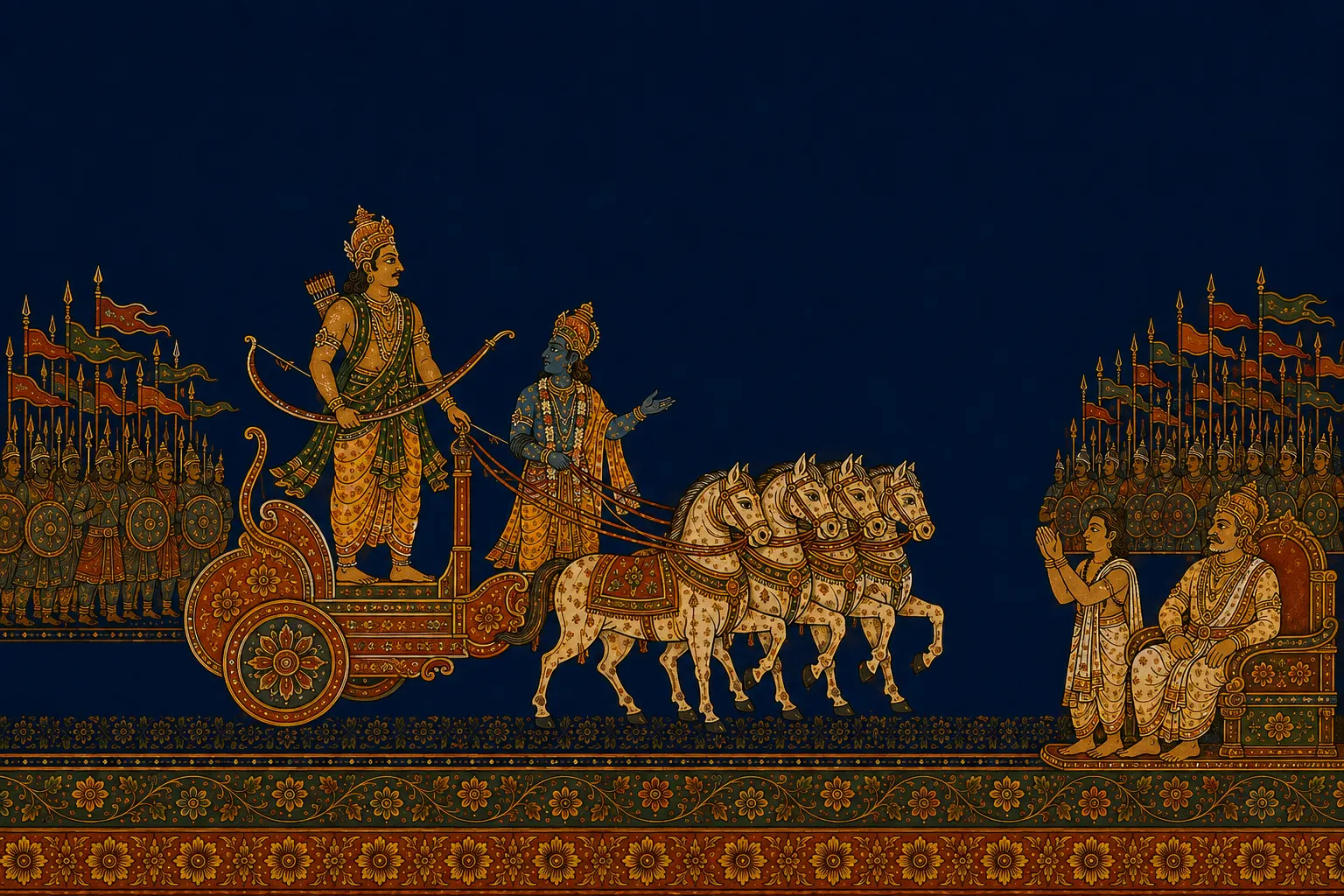
Chapter 18

Liberation and Renunciation

The Final Synthesis

Renunciation and letting go

Arjuna asks for one final distinction — between *sannyasa* and *tyaga*. "Giving up actions driven by desire is one thing," Krishna answers, "and giving up attachment to the fruits of all action is another."

Acts of sacrifice, giving and austerity, he says, should not simply be abandoned because they are action — they are the means of purification. Prescribed duty abandoned through delusion is tamasic renunciation. Duty abandoned because it is troublesome or painful is rajasic renunciation. In sattvic renunciation, the duty is performed, but attachment and the expectation of a fruit are let go.

Five factors

"Every action," Krishna says, "involves five factors — its basis, the doer, the instruments, the various efforts, and fifth, *daiva*" — the divine or circumstantial element beyond any one person's control.

"Whoever looks at these five factors," he says, "and still sees themselves as the sole doer, fails to understand how action actually arises." One who is free of the thought "I am the doer," whose understanding carries no stain, does not really kill even in killing, and is not bound by it.

The threefold everything

Krishna then classifies knowledge, action, the doer, intellect, resolve and happiness according to the three gunas, one final time, sorting the clear from the driven from the dull.

Knowledge that sees one imperishable reality in all beings is sattvic; knowledge that sees only separate, unconnected things is rajasic; knowledge fixed on one small thing as though it were the whole is tamasic. It is the same guna-analysis of the earlier chapters, now turned one last time onto the entire inner life.

Work born of your nature

He returns to duty. "The tasks of society's four orders," he says, "follow from the qualities born of each person's own nature — and a person finds success through devotion in their own work, not by taking up someone else's."

Here the line from Chapter 3 returns, almost in its original form — one's own duty done imperfectly is better than another's done well — and with it, this final chapter reaches back to close the very crisis that opened the whole Gita. "Even a flawed duty," he says, "should not be abandoned — just as fire is never abandoned for its smoke."

"Reflect fully, then act"

Detachment, self-mastery and steady contemplation, Krishna says, lead to the calm of Brahman — and from that calm to supreme devotion, by which a person truly knows him and enters into him. Acting with him as refuge, a person reaches that eternal, unchanging place.

Then Krishna leaves the choice to Arjuna. "I have told you this secret knowledge," he says. "Now weigh it fully, completely — and then do as you see fit." Only after this comes the final, most secret word of all: "Fix your mind on me, love me, offer to me, bow to me. Let go of all duties and take refuge in me alone, and do not grieve — I will free you from every wrong."

Arjuna answers; Sanjaya closes

Arjuna says — his delusion is gone, his memory has returned, his doubt is destroyed. He will act on Krishna's word.

And the Gita does not end on Krishna. Sanjaya turns back to the same blind king he has been addressing from the very start, recalls the whole wonder of the dialogue and the vision, and delivers his own verdict: "Wherever Krishna, master of yoga, and Arjuna, bearer of the bow, stand together — there is fortune, there is victory, there is majesty, there is unshakeable resolve."

Note: Verse 18.66 — "abandon all duties, take refuge in me alone" — is read in sharply different ways: Shankara toward the renunciation of action as a means to knowledge; Ramanuja explicitly *not* as licence to drop obligation; and later Sri Vaishnava tradition as one of the central verses for surrender, *sharanagati*. The Gita ends with Sanjaya's judgement, not Krishna's instruction. In the war that follows in the epic, Arjuna fights — he does not become a pacifist.

Source: Mahabharata — Bhishma Parva, Liberation and Renunciation

Now — how much stayed with you?

Who said it?

At the start of Chapter 18 Arjuna asks for one final distinction — between which two words?

  • Knowledge and action
  • Personal and formless
  • Divine and demonic
  • *Sannyasa* and *tyaga*
Read the whole story — Renunciation and letting go

Krishna answers that giving up actions driven by desire is one thing, and giving up attachment to the fruits of all action is another.

But acts of sacrifice, giving and austerity should not simply be abandoned; they are purifying.

Prescribed duty abandoned through delusion is tamasic renunciation; abandoned because it is troublesome, rajasic; sattvic renunciation performs what should be done while giving up attachment and the fruit.

Fact

How many factors does Krishna say every action involves?

  • Three
  • Five
  • One
  • Countless
Read the whole story — Five factors

Whoever looks at this and still sees the isolated self as the sole doer does not see it as it is.

The one who is free of the thought "I am the doer," whose understanding is not stained, does not really kill even when they kill, and is not bound.

It is a direct challenge to the claim "I alone did this."

Fact

Which line from Chapter 3 returns almost word for word in Chapter 18?

  • "No one can stay actionless even for a moment"
  • "Your own duty done imperfectly is better than another's done well" (3.35 → 18.47)
  • "Your claim is to the action, not the fruits"
  • "Work for the sake of holding the world together"
Read the whole story — Work born of your nature

Krishna says the tasks of the four orders of society follow from qualities born of each person's own nature.

And a person comes to perfection by devotion within their own work rather than by taking up someone else's.

Here the line from Chapter 3 returns almost verbatim — deliberately closing the arc that Arjuna's crisis opened.

What happened?

What does Krishna say at 18.63, immediately before beginning his final "most secret" appeal in 18.64–66?

  • That there is no choice now, he must fight
  • That he should stay silent and keep listening
  • That he should see the universal form again
  • That he has heard this secret knowledge; now he should weigh it fully, completely, and then do as he chooses
Read the whole story — "Reflect fully, then act"

Verse 18.63: "having reflected on this fully, do as you wish."

Then, across 18.64–66, comes the "most secret of all" — fix your mind on me, love me; and finally, let go of all duties and take refuge in me alone, and do not grieve.

So Krishna leaves the decision to Arjuna, then makes his final appeal.

Riddle

I am the Gita's longest chapter, and I am the synthesis of the whole teaching. I do not end on Krishna's words. Which chapter am I?

  • Chapter 18
  • Chapter 2
  • Chapter 11
  • Chapter 9
Read the whole story — Not on Krishna, but on Sanjaya

Chapter 18 has 78 verses — the most in the Gita.

Arjuna says his delusion is gone, his memory recovered, his doubt dissolved.

And then the Gita does not end with Krishna — Sanjaya turns back to the blind king and gives his own verdict.

Who am I?

I am the Gita's last speaker — not Krishna. I turn to the blind king and say: where Krishna, master of yoga, and Arjuna, bearer of the bow, stand, there are prosperity and victory. Who am I?

  • Arjuna
  • Krishna
  • Sanjaya
  • Vyasa
Read the whole story — The last word is Sanjaya's

Verse 18.78: "where Krishna, master of yoga, and Partha, bearer of the bow..."

Sanjaya recalls the wonder of the dialogue and the vision, and says he heard it through Vyasa's grace.

So the Gita's frame does not break at the end — the reader is still where Dhritarashtra is.

Why is that?

Why does Krishna say "do as you choose" (18.63) before he begins the final "most secret" sequence?

  • Because he does not care what Arjuna decides
  • Because Krishna first gives Arjuna room to weigh it fully (18.63), and then makes his final appeal
  • Because he is taking back what he said
  • Because Arjuna had already decided to fight
Read the whole story — Room to reflect, then the appeal

Krishna says nature will compel Arjuna toward his own disposition (18.59–60), but also tells him to reflect and then choose (18.63).

Then, across 18.64–66, the final appeal: fix your mind on me, and at last "abandon all duties, take refuge in me alone."

So there is a tension in the Gita — compulsion and choice both — and it is not silently resolved.

The texts disagree

How do the schools read verse 18.66 — "abandon all duties, take refuge in me alone"?

  • All agree it means dropping all ethics and responsibility
  • All agree it applies only to renouncers
  • The verse is regarded as a later insertion
  • Shankara reads it as total renunciation of rites and duties on the path of liberating knowledge; Ramanuja explicitly does *not* read it as licence to drop obligation; later Sri Vaishnava tradition makes it a central verse for surrender
Read the whole story — One verse, sharp disagreement

The chapter has just spent many verses defining right action and Arjuna's duty.

So "18.66 means ignore ethics and law" is not a safe, text-neutral reading.

This account presents all three readings without treating any one of them as the uncontested meaning of the Gita.

Put it in order

In what order do the teaching and the story move in Chapter 18?

  • Sanjaya's verdict → Arjuna's answer → the five factors → renunciation and letting go
  • Arjuna's answer → Sanjaya's close → *sannyasa* and *tyaga* → the five factors
  • The distinction of *sannyasa* and *tyaga* → the five factors of every action → the guna-analysis of knowledge, action, doer and happiness → work born of your nature (3.35 returns) → "reflect fully," then 18.66 → Arjuna's answer → Sanjaya's close
  • The five factors → *sannyasa* and *tyaga* → Sanjaya's close → Arjuna's answer
Read the whole story — Synthesis, then the frame closes

The chapter opens on one last distinction and closes on Sanjaya's verdict.

In between is the whole Gita's guna-analysis one more time, and the deliberate return of the line from Chapter 3.

And at the very end — not Krishna but Sanjaya — telling the blind king what he has witnessed.

Later tradition

"The Gita ends with Krishna's final instruction, and Arjuna becomes a pacifist" — is this right?

  • No
  • Yes, 18.66 is the Gita's last verse
  • Yes, Arjuna leaves the war
  • No
Read the whole story — Two misreadings, together

The Gita's last verse is 18.78 — Sanjaya's, not Krishna's.

Arjuna says "I will act on your word," and then the battle proceeds.

Gandhi reads it as allegory; but in the epic's plot Arjuna fights — he does not become a pacifist.