
Chapter 15
The Supreme Person
The Upside-Down Tree
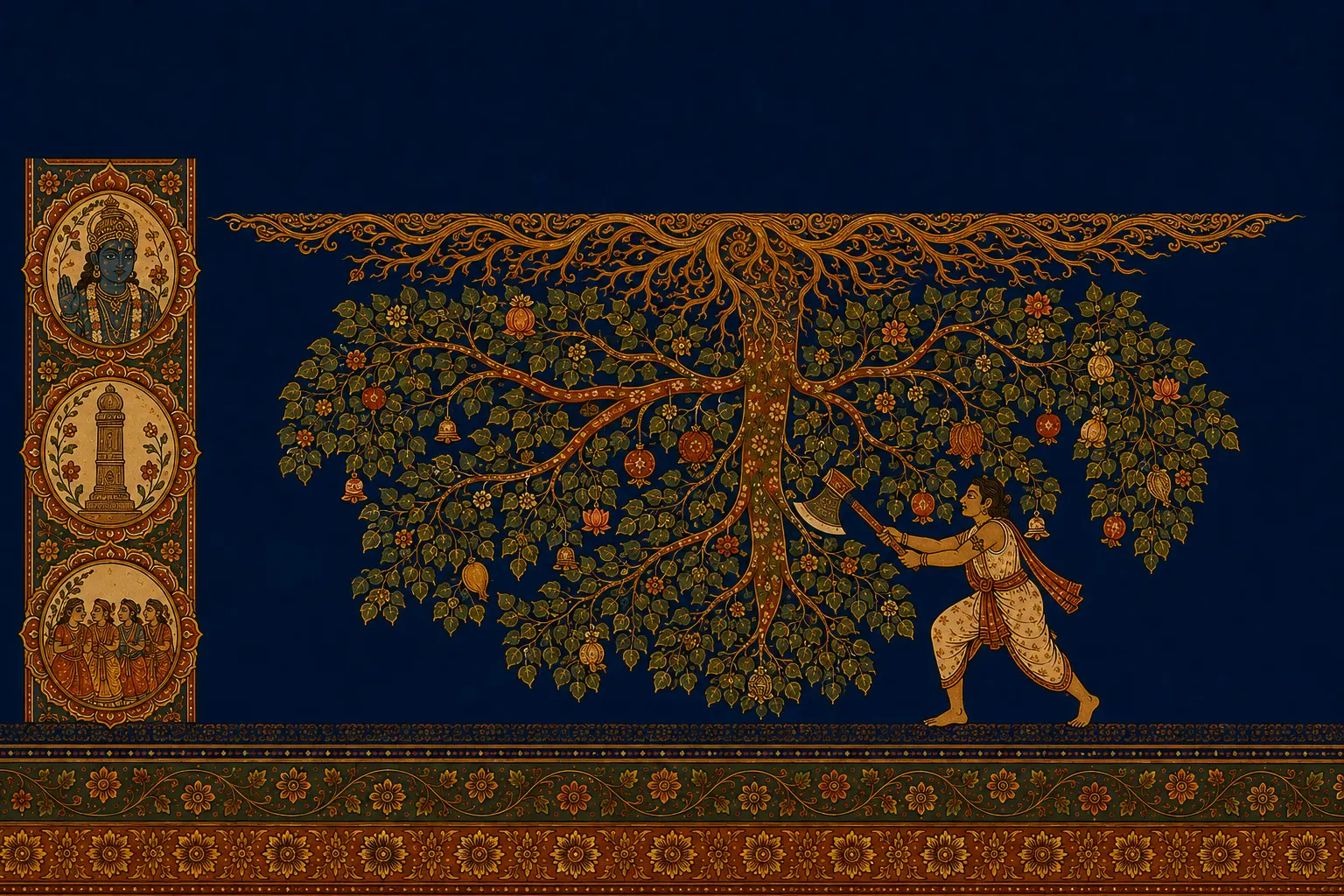
The inverted tree
Krishna binds the world of birth and death into one striking picture — an *ashvattha* tree growing upside down, its roots above, its branches spreading below, fed by the qualities of nature, its buds the objects of the senses, its lower roots reaching down into the actions that bind.
"Its true form," he says, "is never seen by anyone standing inside it" — not its beginning, not its end, not its foundation. There is only one tool for cutting it down: the firm axe of non-attachment. Then a person searches for the place from which, once reached, there is no return.
The traveller
Within the world, Krishna says, each living being is an eternal portion of him. That portion draws to itself the five senses and the mind, both resting in nature.
When it takes up a body, and when it leaves one, it carries the senses and mind along — exactly the way a passing breeze lifts scents from the places where they had settled.
The one in the heart
"I am the light that lives in the sun, in the moon, in fire," Krishna says, "lighting the whole world." He enters the earth and holds up every being with his own energy, and becomes the very sap that feeds the plants.
He is the digestive fire in the body of every living thing, joined with the two breaths, breaking down the four kinds of food. He is seated in the heart of everyone, and from him rise memory, knowledge, and their loss; he is what all the Vedas exist to know.
The three
"In this world," Krishna says, "there are two 'persons' — the perishable, which is every being, and the imperishable, the unchanging principle standing above them."
Beyond both stands a third — the highest, the Supreme Person, *Purushottama*, who enters the three worlds and holds them up. "Because I am beyond the perishable, and higher even than the imperishable," he says, "the world and the Vedas both know me as Purushottama." The one who knows him without confusion worships him with their whole being.
Note: None of the three schools reads verse 15.7's "a portion of myself" as a literal piece broken off God; each avoids that reading in its own way. The inverted-tree image echoes the Katha Upanishad. Though only twenty verses long, Chapter 15 has a prominent place in recitation; in some traditions it is chanted before meals.
Source: Mahabharata — Bhishma Parva, The Supreme Person