Chapter 9

The Royal Secret

The Royal Secret

The king of secrets

Krishna calls this the king of knowledge, the king of secrets — supremely purifying, directly knowable, in accord with dharma, easy to practise, and enduring.

"I tell it to you," he says to Arjuna, "because you hold no scorn, no mockery toward me." Those who have no faith in it, he adds, never reach him — they turn back into the round of death.

In him, not contained by him

"All beings rest in me," Krishna says, "and yet I am not contained by them — my being does not depend on holding them." At the close of an age they return into his nature; at the start of one he sends them out again, presiding over the whole process without ever being caught in it.

He compares himself to the vast wind that moves everywhere in space and yet is held by nothing. Nature does the work under his eye; he stays unattached, seated apart, bound by none of it.

The overlooked divinity

The deluded, seeing only his human form, dismiss him — not knowing the greater nature that form belongs to, taking him for an ordinary man who has somehow become important.

The great-souled know that nature, and worship him with minds that turn nowhere else — speaking of him, striving for him, bowing to him, holding fast to him.

A leaf, a flower

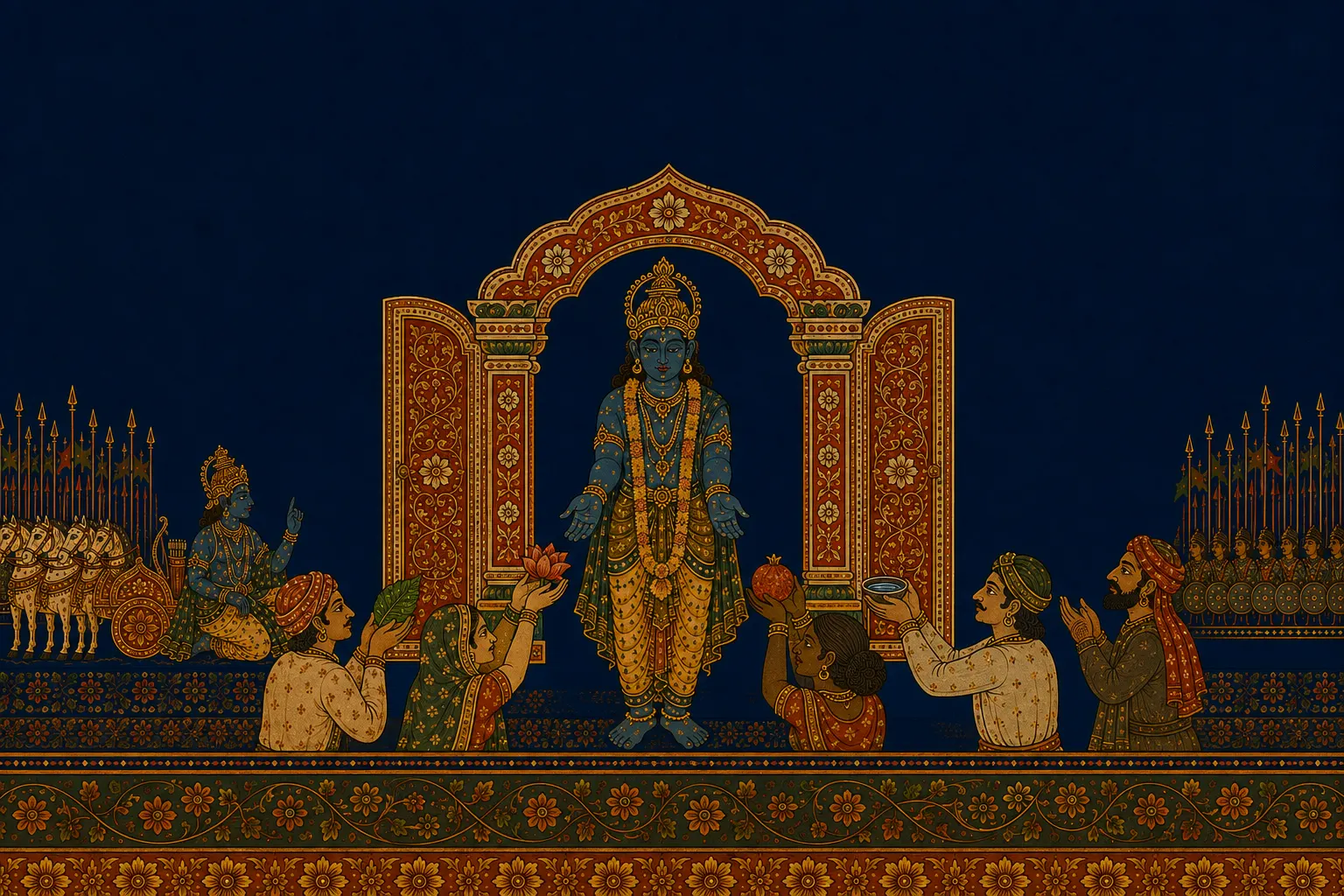
Whoever offers him a leaf, a flower, a fruit, or even water, with devotion — that offering he accepts, because it comes from a heart already turned toward him. The value lies in the devotion, never in the cost.

"Whatever you do," he tells Arjuna — "whatever you eat, whatever you give away, whatever discipline you keep — do it as an offering to me, and you will be freed from the bonds of action, from its good results and its bad alike."

The open door

He states his impartiality flatly. "I am the same toward all beings — none is hateful to me, none is dear." Yet those who worship him with devotion are in him, and he in them.

And then one step further. Even a person of very poor conduct who turns to him with undivided devotion should be counted as rightly resolved — because such a person quickly becomes righteous, and comes to lasting peace. This devotion, he says, stands open to anyone who takes refuge in him, whatever their birth or station.

Note: Verse 9.30 describes a transformation, not a permission — 9.31 immediately adds that such a devotee quickly becomes righteous. The wide social wording of 9.32 is read in different ways across the commentaries. Heaven reached through the merit of rituals (9.20–21) is explicitly said to be temporary, ending when the merit is spent.

Source: Mahabharata — Bhishma Parva, The Royal Secret

Now — how much stayed with you?

Fact

What does Krishna call this knowledge?

  • The hardest and rarest knowledge
  • The king of knowledge and the king of secrets
  • A knowledge made only for renouncers
  • A knowledge not found in the Vedas
Read the whole story — The king of secrets

Krishna tells it to Arjuna, he says, because Arjuna is not the kind of person who sneers at him.

Those who have no faith in it do not reach him, and turn back into the round of death.

The chapter's name is raja-vidya raja-guhya — royal knowledge, royal secret.

Fact

By what image does Krishna describe his relation to beings?

  • Like a potter and a pot
  • Like the vast wind that moves everywhere in space and yet is held by nothing
  • Like gems on a thread
  • Like dust on a mirror
Read the whole story — In him, not contained by him

All beings rest in Krishna — and yet, he says in the same breath, they do not rest in him; his being does not depend on holding them.

At the close of an age they return into his nature; at the start of one he sends them out again.

He presides over the whole process without being caught in it.

What happened?

What simple offering does Krishna say he accepts?

  • Only gold and clarified butter
  • Only an animal sacrifice
  • Only recitation of the Vedas
  • A leaf, a flower, a fruit, or even water
Read the whole story — A leaf, a flower

That offering Krishna accepts because it is offered from a heart that is turned toward him.

The value is in the devotion, not the cost.

"Whatever you do — whatever you eat, whatever you give away, whatever discipline you keep — do it as an offering to me."

Who said it?

"I am the same toward all beings; none is hateful to me and none is dear" — who says this?

  • Krishna
  • Arjuna
  • Sanjaya
  • Vak Ambhrini
Read the whole story — The open door

Krishna states his impartiality flatly: he is the same toward all.

Then a further step: even a person of very bad conduct who turns to him with undivided devotion should be regarded as having resolved rightly, because such a person soon becomes righteous.

This devotion is open to anyone who takes refuge in him, whatever their birth or station.

Riddle

I am the knowledge Krishna calls a "king" — twice. I am supremely secret, yet easy to practise. Which chapter am I?

  • Chapter 7, knowledge and realisation
  • Chapter 13, the field and its knower
  • The king of knowledge and the king of secrets, easy to practise
  • Chapter 18, liberation and renunciation
Read the whole story — King, twice

In verse 9.2 Krishna calls this knowledge both raja-vidya and raja-guhya.

Chapter 7 stresses how rare the knowledge is; Chapter 9 stresses how accessible — "easy to do."

The difference is that here devotion is at the centre, and the door of devotion is open to everyone.

Who am I?

I am the father of this universe, and the mother, and the sustainer, and the grandsire — one speaker says all of this in a single verse. Who am I?

  • Brahma, the creator
  • Krishna
  • The universal form, a separate being
  • Vak Ambhrini
Read the whole story — Father and mother, at once

In verse 9.17 Krishna calls himself at once the father, the mother, the sustainer and the grandsire.

It is a foretaste of the catalogue of Chapter 10 — but here the subject is ritual and the cosmos.

Whatever is offered in any sacrifice, Krishna says, comes to him, under whatever name.

Why is that?

Why does Krishna say even "a person of very bad conduct" who turns to him with undivided devotion should be regarded as rightly resolved?

  • Because devotion licenses wrongdoing
  • Because conduct carries no weight
  • Because that person was not really bad after all
  • Because 9.30 describes a transformation, not a permission
Read the whole story — Transformation, not permission

Read alone, 9.30 can look as though devotion excuses a bad act.

But 9.31 adds: "quickly he becomes righteous."

So it is about change, not a licence.

The texts disagree

Verse 9.32 names specific categories — those of "sinful birth," women, Vaishyas and Shudras — as able to reach the highest goal. How is this read?

  • All commentators agree it means the total end of the caste system
  • All agree it applies only to men
  • The verse names those categories explicitly; how "sinful birth" is to be construed, and how far the universalising reaches, is read differently across the commentaries
  • The verse is regarded as a later insertion
Read the whole story — An unusually open verse

9.32 names those of "sinful birth," women, Vaishyas and Shudras as able to take refuge in Krishna and reach the highest goal.

Shankara, Ramanuja and Madhva each read it within their own framework.

But all must grant that the verse's wording is deliberately wide — and that is what makes it a subject of debate.

Put it in order

In what order does Chapter 9's teaching move?

  • The king of secrets → all beings rest in him, yet he is not contained (the wind image) → the deluded disregard his human form → a leaf, a flower, a fruit → the open door (impartiality, and the transformation of the ill-behaved)
  • The open door → a leaf, a flower → the king of secrets → the wind image
  • A leaf, a flower → the wind image → the king of secrets → the open door
  • The open door → the king of secrets → a leaf, a flower → the wind image
Read the whole story — From secret to open door

The chapter opens on a high claim — this is the king of knowledge — and closes on its most open statement.

In between: Krishna's pervasiveness, his oneness with ritual, and the simple offering.

At the end, impartiality and transformation — the door of devotion is not bound by birth.

Later tradition

"Verse 9.30 excuses the wrongdoer for their wrongdoing" — is this right?

  • Yes, Krishna says the devotee can do as they please
  • Yes, and so conduct does not matter
  • No
  • No
Read the whole story — Two verses, read together

Quoted alone, 9.30 yields the wrong meaning.

9.31 completes it: devotion changes a person, so they quickly become righteous.

Heaven reached through the merit of rituals (9.20–21) is also explicitly said to be temporary, ending when the merit is spent.