
Chapter 2
The Way of Knowledge
Two Answers to Grief
"I am your pupil"
Krishna's first words are not gentle. "This faintness is unworthy of you," he says. "Shake it off and stand up."
Arjuna does not stand. A warrior who moments ago stood at the front of every battle now admits that pity and confusion have tangled his own sense of right and wrong — he cannot tell the two apart. For the first time, he asks openly to be taught. "I am your pupil," he says, and hands the decision entirely to Krishna. Only after this does the teaching begin — both armies still halted, still waiting.
What does not die
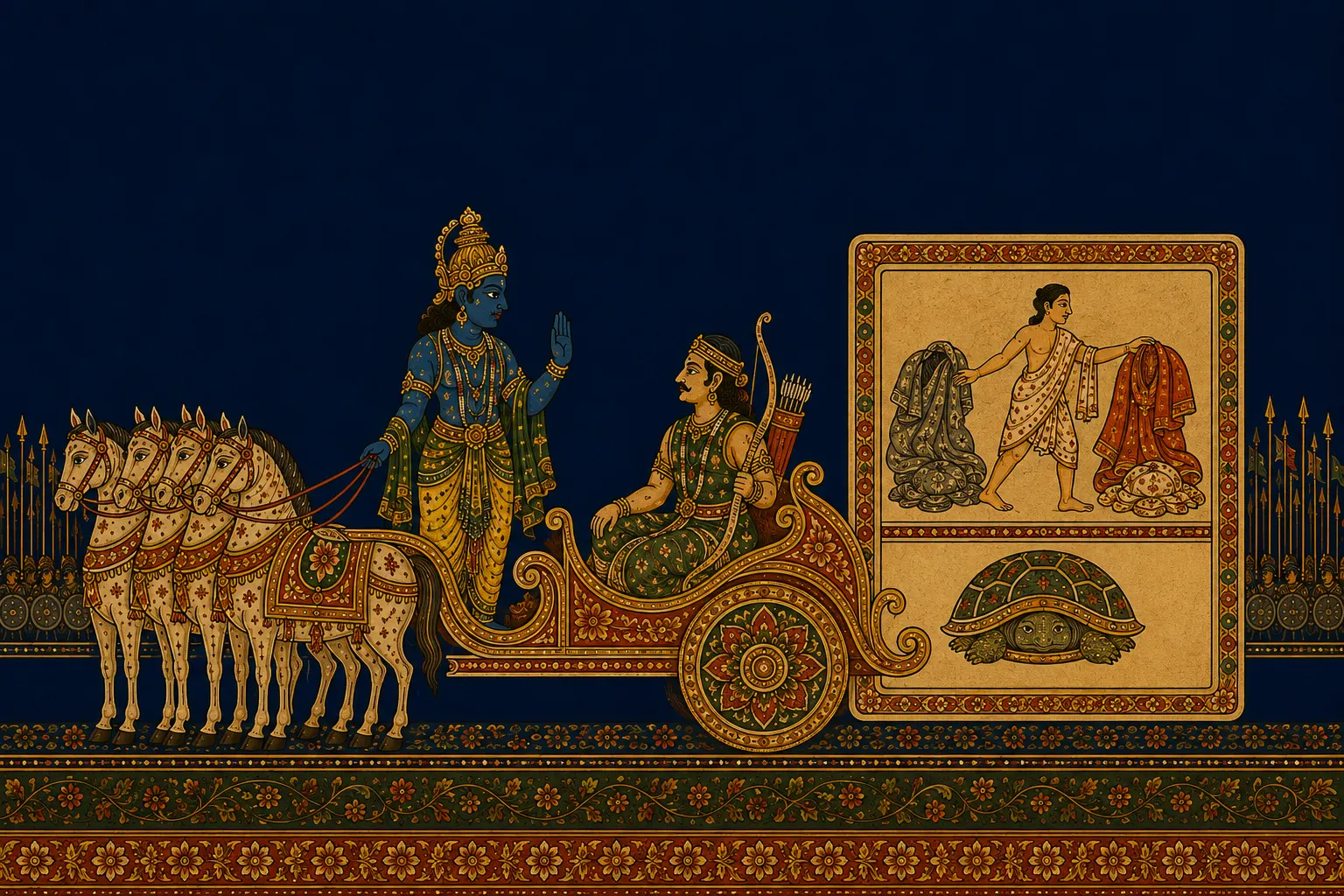
Krishna's first argument is about the self. "The wise," he says, "grieve for neither the living nor the dead." What dwells in the body is never born and never dies — the body wears out and is set aside, the way a person takes off worn clothes and puts on new ones.
Just as the self passes through childhood, youth and old age within one body without being lost, so it passes into another body when this one falls. Weapons do not cut it, fire does not burn it, water does not wet it. For what is eternal, unmoving — truly, there is nothing here to grieve.
Your work is your own
Then Krishna sets down a second argument, entirely different — not metaphysics now, but duty. For a warrior, he says, there is no greater good than a war fought for what is right; such a chance arrives like an open door, and very few ever get it.
To turn away now would be to lose his own duty and his reputation in a single stroke. People will tell the story of his broken nerve for years — and for a man who has built a name, that disgrace is worse than death.
Act, but not for the fruit
At the centre of it all stands verse 2.47 — one of the Gita's most quoted lines: your claim is to the action alone, never to the fruit. Do not make the longing for results your reason to act — but do not use that as an excuse to do nothing either.
Work done in this even-minded spirit does not bind the one who does it. Krishna calls this very evenness a form of yoga: weighing success and failure on the same scale, treating them as equal, so that the action leaves no residue behind.
The steady mind
Arjuna asks: what does such a person actually look like — how do they sit, speak, move?
Krishna answers with a portrait — the *sthitaprajna*, one whose wisdom has settled: content within themselves, free of craving, fear and anger, drawing the senses back from their objects the way a tortoise senses danger and pulls its limbs inward, unmoved alike by good fortune and bad.
Then he traces the opposite process — how a person begins to fall apart. Dwelling on an object breeds attachment; attachment breeds desire; thwarted desire turns to anger; anger clouds judgement — and from there memory fails, discernment fails, and the person loses themselves.
Note: Chapter 2 is the longest chapter until Chapter 18 and works as a compressed preview of the whole Gita — the self, duty, action without attachment, and the steady mind all appear here first. Verse 2.47 does not say that results do not matter, or that action should be careless; it denies the fruit as the *reason* for acting. "Steady wisdom" means freedom from compulsive craving, fear and anger, not the absence of feeling.
Source: Mahabharata — Bhishma Parva, The Way of Knowledge