
Chapter 17
The Threefold Faith
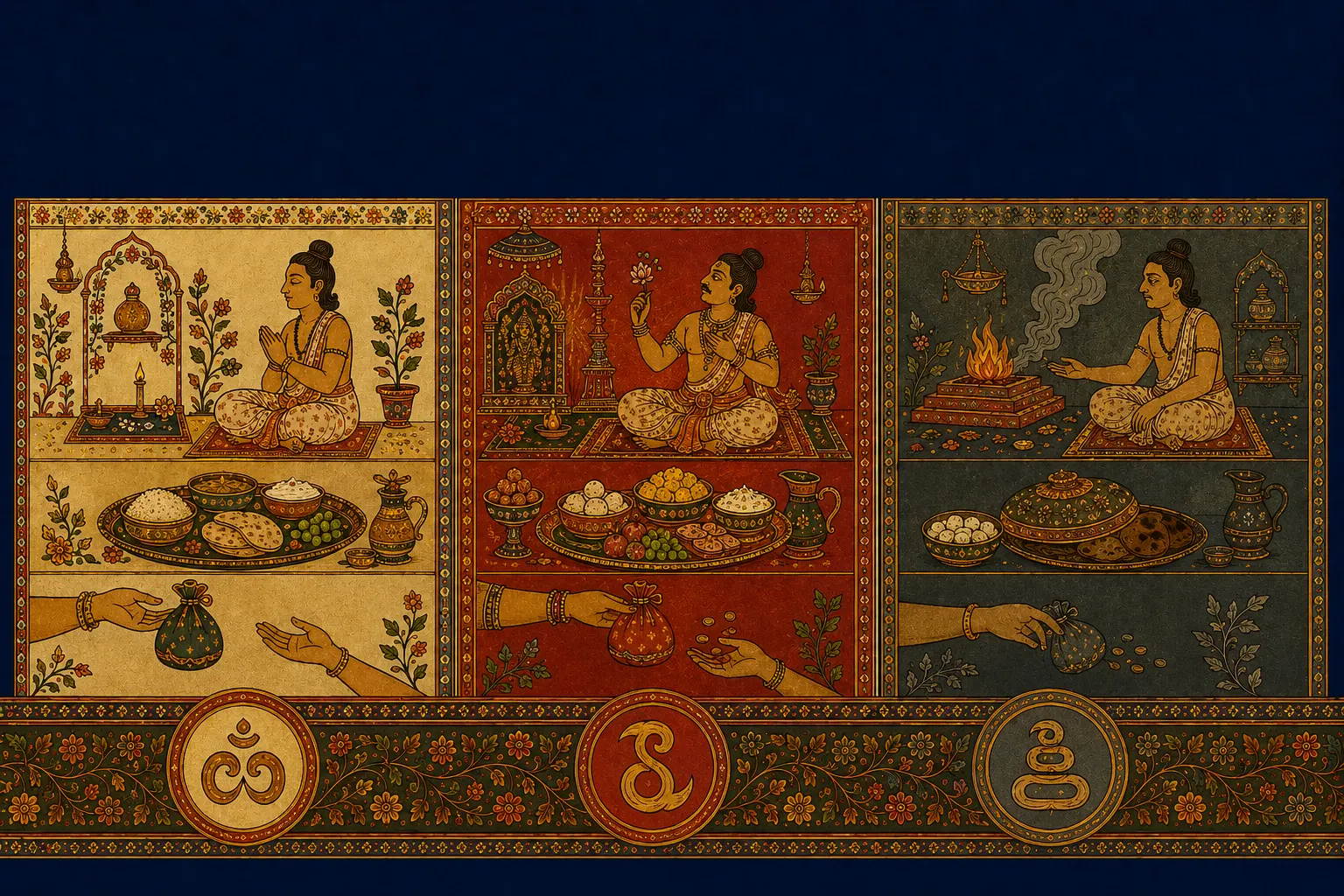
Faith Takes Three Forms
Faith follows nature
Arjuna asks about people who worship with faith but set the scriptural rules aside — where do they stand, in clarity, passion or darkness?
Krishna answers by turning the three qualities onto faith itself. "Each person's faith," he says, "matches their own constitution." And then a line that carries the whole chapter: "A person is made of their faith — as the faith, so the person."
Extreme austerity, and food
Before the threefold analysis, Krishna condemns one thing outright: those who take up fierce austerities not enjoined by scripture, driven by hypocrisy and ego, torturing the elements within the body — and him seated within them too. "That," he says, "is demonic resolve, not discipline."
Then he sorts food by its effects. Some food strengthens life, health, cheer and vigour, and is mild, firm and pleasant. Some is sharp, sour, salty and burning, and brings pain and sickness. Some is stale, tasteless, half-rotten, left over, unfit to offer.
Sacrifice, austerity, giving
Each of these Krishna sorts the same way, by motive. Sacrifice performed as a duty, mind settled, no eye on the reward, is of the highest kind; performed for show or for a result, the middle kind; performed with no rule, no food for the guests, no sacred word and no faith, the lowest.
"The austerity of speech," he says, "is speech that is truthful, kindly, beneficial, and does not agitate the one who hears it." Giving is highest when it is given simply because it is right to give — to a fit person, at a fitting time and place, expecting nothing back.
Om Tat Sat
Three words — Om, Tat, Sat — stand as designations of Brahman, spoken over acts of sacrifice, austerity and giving to fix them in place and connect them back to the source.
And whatever is done without faith, Krishna says — sacrifice, gift or austerity — is *asat*: without true spiritual worth, here or in what comes after.
Note: Chapter 17 does not name onions or garlic; later traditions place those within its quality-scheme. Austerity here is not self-punishment — ego-driven bodily torture is condemned at the start of the chapter — but the discipline of body, speech and mind. The verses classify food by its qualities and effects; detailed culinary lists are commentarial and cultural additions.
Source: Mahabharata — Bhishma Parva, The Threefold Faith