
Chapter 10
The Divine Glories
Signs of the Divine
Source of gods and sages
"Even the gods and the great sages do not know my origin," Krishna says, "because I am the source they all arise from." Whoever knows him, unborn and beginningless, as the great lord of the worlds, is freed from every fault.
To those who love him and speak of him constantly, their whole lives turned toward him, he gives an inner clarity by which they find their way to him. "Out of compassion," he says, "I myself light the lamp of knowledge in them, and burn away their darkness."
Arjuna accepts
Arjuna answers with acceptance. He calls Krishna the supreme Brahman, the supreme abode, the purifier, the primal unborn — and adds that the sages Narada, Asita, Devala and Vyasa have said the very same, and now Krishna is telling him directly.
"I take all of this as true," he says, "and I know that neither gods nor demons know your full manifestation." Then he asks something practical: "In what forms should I hold you in mind, when I sit to think of you?"
The catalogue
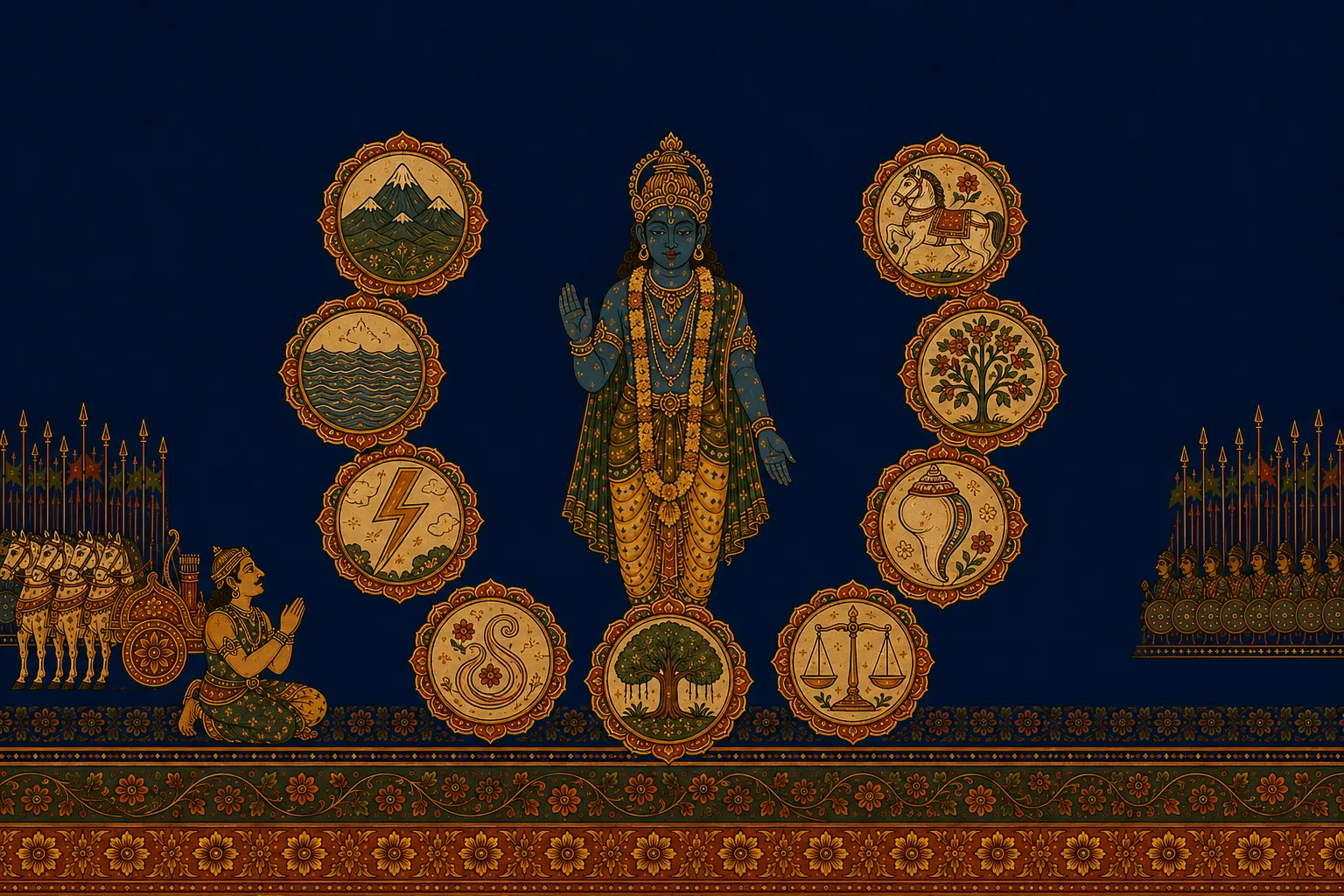
Krishna gives a selection, not a system. "I am the self seated in the heart of every being," he says, "their beginning, their middle, their end. Among mountains, I am Meru; among flowing waters, the Ganga; among weapons, the thunderbolt; among beasts, the lion; among letters, the first — A; among the sciences, the knowledge of the self; among deceptions, the gambling of the cunning."
He names dozens more — deities, sages, seasons, meters, virtues, even "the silence among secrets" — and then says outright that the list has no end at all; this is only a handful of the most prominent.
One fraction
The principle behind the list closes the chapter. "Whatever anywhere is glorious, or prosperous, or strong," Krishna says, "has sprung from a single spark of my own splendour."
And he needs no more than that to run the world. "I hold up this entire universe," he says, "with one fragment of myself — and stand unmoved."
Note: Krishna states plainly that the list is only a set of prominent examples and that his manifestations have no end. The repeated formula "I am X" is read very differently by the three schools — as an underlying identity, as the dependent modes and bodies of a personal Lord, or as supreme presence and control over things that stay real and distinct.
Source: Mahabharata — Bhishma Parva, The Divine Glories