Chapter 1

Arjuna's Despair

Before the First Arrow

The blind king's question

"Speak, Sanjaya" — in the halls of Hastinapura sits the blind king Dhritarashtra, his eyes useless, his ears his only trust. The dust of Kurukshetra never reaches him, but his question cuts like a blade: "On the field of dharma, at Kurukshetra, gathered and eager to fight — what did my people and the sons of Pandu do?"

That is all. After this, Dhritarashtra never speaks again in the whole Gita — one verse out of seven hundred. Everything that follows comes in the voice of his counsellor, Sanjaya. Vyasa had given Sanjaya a strange gift — divine sight and divine hearing, so that sitting in Hastinapura he could see and hear every moment on the field at Kurukshetra and report it to the blind king. So the reader too is placed exactly where Dhritarashtra is — far off, unknowing, dependent on the sounds of a war already begun.

Between the two armies

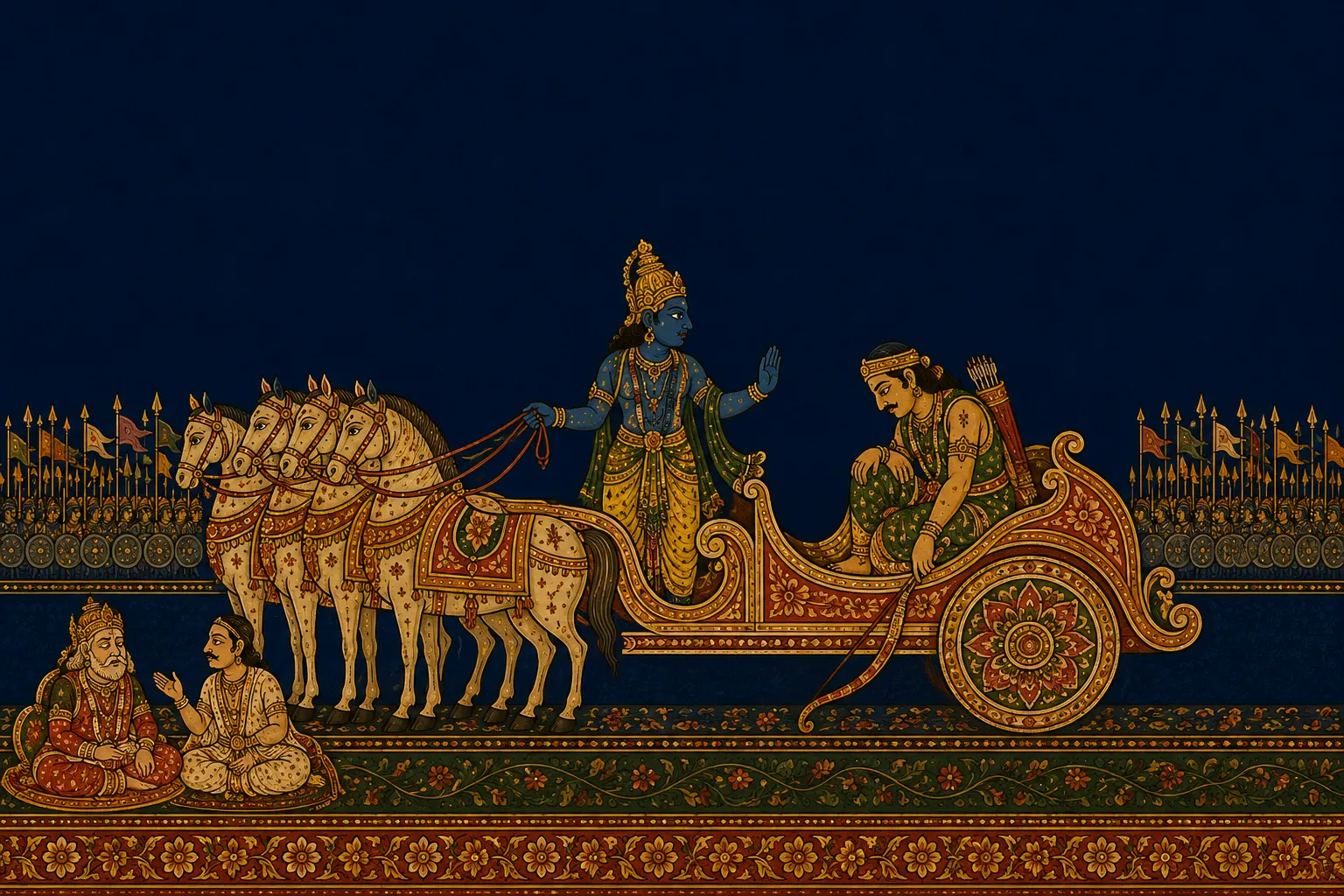
On the field, the conches have already sounded. Both armies stand arrayed, waiting only for the first blow. Arjuna turns to his charioteer. "Krishna, draw the chariot up between the two armies — I need to see the men I have come to kill."

Krishna pulls the reins. The chariot rolls forward and comes to a stop directly before Bhishma, Drona, and the assembled kings. Arjuna's eyes run down one line, then the other — and what he sees is no stranger's army. Fathers and grandfathers, the teachers who taught him to hold a bow, uncles, brothers, sons, friends from childhood — arrayed on both sides, ready to die.

The body gives way

Something breaks inside Arjuna. His limbs go slack, his mouth dries, a fever-like tremor runs across his skin, the hairs of his body stand on end. Gandiva — the bow that has never once slipped from his hand — slides from his fingers. "I cannot stand, Krishna," he says.

"My mind is reeling. I see nothing good in this — no victory, no kingdom, no pleasure, if it is bought this way." Even the omens, he adds, point the wrong way.

Arjuna's argument

This is not fear of death — Arjuna makes that clear. His case is something else: a throne won in the blood of kin and teachers is worthless, and this killing will drag the whole order down with it.

He speaks of the sin that falls on those who destroy a family, of the ancient rites of clan and ancestor breaking down when no one is left to perform them, and of the confusion of dharma and lineage that follows. On the strength of that argument he says: better to be killed unarmed and unresisting than to win such a war.

He sits down

The bow and arrows fall from his hands. Arjuna sinks back into the halted chariot, his mind filled with grief.

The war has not begun. Neither has the teaching. The first chapter stops right here — at the exact crisis that makes Krishna's answer necessary: a warrior standing at the threshold of battle, now unable to act.

Note: The traditional name of the chapter, Arjuna-vishada-yoga, means "the yoga of Arjuna's despondency"; it is a title convention, and no spiritual method is taught here. Dhritarashtra speaks only one verse in the entire Gita — the first. Arjuna's fear of *varna-sankara*, the collapse and mixing of the social order, is his own argument on the field and not yet anything Krishna has endorsed; the later chapters must be read on their own terms.

Source: Mahabharata — Bhishma Parva, Arjuna's Despair

Now — how much stayed with you?

Fact

Who speaks first in the Gita?

  • Krishna
  • Arjuna
  • Sanjaya
  • The blind king Dhritarashtra
Read the whole story — A single verse

Dhritarashtra speaks only one verse in the whole 700-verse Gita — the first. After that he is silent, and everything that follows is Sanjaya's answer.

His question is not neutral either: "my people and the sons of Pandu" — the sides are already split in his mouth.

So the Gita opens not with Krishna but with a blind king's question, and the reader is placed exactly where Dhritarashtra is.

Who am I?

I sit far from the field, and yet the whole course of the war and the Krishna–Arjuna dialogue reach me — because Vyasa gave me an extraordinary sight. Who am I?

  • Sanjaya
  • Dhritarashtra
  • Vidura
  • Vyasa
Read the whole story — A conversation inside a report

The Gita has nested voices: the Mahabharata's narrator, then Dhritarashtra and Sanjaya, then Sanjaya's report, then the Krishna–Arjuna dialogue.

The larger Mahabharata frame says Vyasa granted Sanjaya extraordinary sight and hearing so he could report the war to Dhritarashtra. The Gita assumes this rather than re-explaining it.

In Chapter 11, when the universal form is first described, it is not Arjuna but Sanjaya who describes it, still narrating to the blind king.

Who said it?

"Halt the chariot in the open ground between the two armies" — who says this, and to whom?

  • Krishna, to Arjuna
  • Dhritarashtra, to Sanjaya
  • Arjuna, to Krishna
  • Bhishma, to Krishna
Read the whole story — Between the armies

The conches had sounded, the formations were set. Before the first clash, Arjuna asked his charioteer Krishna to draw up in the open ground.

Krishna drew the chariot up in front of Bhishma and Drona and the assembled kings — Bhishma the patriarch and Drona the teacher, among the hardest for Arjuna to face.

Arjuna looked down both lines and saw not an enemy army but his own people, and the crisis began there.

What happened?

What happens to Arjuna when he looks at the two armies?

  • He sounds his war conch at once
  • His body gives way
  • He asks Krishna for the first teaching
  • He recognises that Krishna is God
Read the whole story — The body gives way

Arjuna's crisis comes with concrete physical symptoms: trembling, hair on end, burning skin, dry mouth, a slipping bow, an inability to stand, a whirling mind.

Then he let the bow and arrows fall and sat down in the halted chariot, his mind sunk in grief.

The fighting had not begun, and neither had the teaching. Chapter 1 is the crisis that makes the answer necessary.

Fact

What is Arjuna's central argument — why does he refuse to fight?

  • That he is afraid to die
  • That he does not trust Krishna
  • That his bow is broken
  • That a throne won with the blood of kin and teachers is worthless, and that the killing would pull the whole order down with it
Read the whole story — Arjuna's argument

Arjuna speaks of the sin that falls on those who destroy a family, of the ancient rites of clan and ancestor failing, and of the confusion of duties and lineages that follows.

On the strength of that argument he concludes it would be better to be killed unresisting and unarmed than to win such a war.

This argument is Arjuna's own — nothing Krishna has endorsed — and the later chapters overturn it.

Riddle

I am known by the name of a "yoga," yet no spiritual method is taught in me — I only record a breakdown. Which chapter am I?

  • Chapter 2, the yoga of knowledge
  • Chapter 6, the yoga of meditation
  • Chapter 1, Arjuna-vishada-yoga
  • Chapter 18, the yoga of liberation and renunciation
Read the whole story — "Yoga" in the name, a crisis inside

Every chapter's traditional name ends in "-yoga" — a way of organising the text, not one fixed meaning.

Chapter 1 is called the yoga of despondency because Arjuna's despondency is its whole subject: a warrior, before combat, unable to act.

This is why the Gita's teaching is taken to begin in Chapter 2, not Chapter 1.

Why is that?

Why does the Gita open with Dhritarashtra's question rather than with Krishna?

  • Because the whole Gita is a report
  • Because Dhritarashtra is the Gita's main character
  • Because Krishna was not on the field at the time
  • Because Dhritarashtra is the one who wanted the war
Read the whole story — A reader on the threshold

The Gita's philosophical dialogue is never, in the epic itself, detached from the coming war or from Dhritarashtra's listening.

It is not precise to make Dhritarashtra a simple pro-war villain — in the Udyoga Parva he repeatedly fears the consequences and sends Sanjaya with peace language, yet keeps enabling Duryodhana.

The first verse — "on the field of dharma, at Kurukshetra" — sets the frame: this is the field of dharma, and what is said there reaches a blind king.

The texts disagree

Arjuna fears *varna-sankara*, the collapse and mixing of the social order. How should this fear be read?

  • As Krishna's teaching
  • As the Gita's central doctrine
  • All scholars agree it means the modern caste system
  • As Arjuna's own argument, before Krishna's answer
Read the whole story — A crisis argument, not a doctrine

Arjuna fears that if the men of a family are killed, family rites break, "the women are corrupted," lineages mix, and the ancestor offerings of rice and water stop.

This whole chain is Arjuna's — and Krishna's very next move is to challenge the conclusion Arjuna draws from it.

Verses 4.13 and 18.41 do have Krishna speak of the fourfold order, "according to guna and karma," and how that connects to birth-based caste is heavily disputed. Chapter 1's fear is a separate thing.

Put it in order

What is the correct order of events in Chapter 1?

  • Arjuna sits down → the conches sound → the chariot comes between the armies → Dhritarashtra asks
  • Dhritarashtra asks → the armies sound their conches → Arjuna has the chariot drawn between them → seeing his own people, he breaks → he lets the bow fall and sits down
  • Krishna teaches → Arjuna sounds his conch → the chariot halts
  • Arjuna sees the universal form → then despairs → then sits down
Read the whole story — The shape of one chapter

Chapter 1 is a single downhill slope: the king's question, the formal opening of battle, Arjuna's demand to see whom he must fight, the crisis of recognition, and finally the refusal.

There is no teaching in between — only the situation that makes the teaching necessary.

The next chapter picks up exactly where this one leaves off: Arjuna seated, both armies waiting.

Later tradition

"The Gita begins with Krishna speaking" — is this common belief right?

  • Yes, Krishna speaks the first verse
  • No
  • Yes, Krishna and Arjuna speak the first verse together
  • No
Read the whole story — A misreading, often repeated

Popular editions often quote the Gita from Chapter 2's "the wise grieve for neither the living nor the dead," so it can look as though Krishna opens it.

But in the text the first words are Dhritarashtra's, then Sanjaya's; Krishna first speaks at 2.2, and the sustained teaching on the self begins at 2.11.

This is not a small point: the Gita deliberately opens with a blind king's partisan question, not with a divine announcement.