Chapter 11

The Universal Form

A Vision Arjuna Cannot Bear

Arjuna asks to see

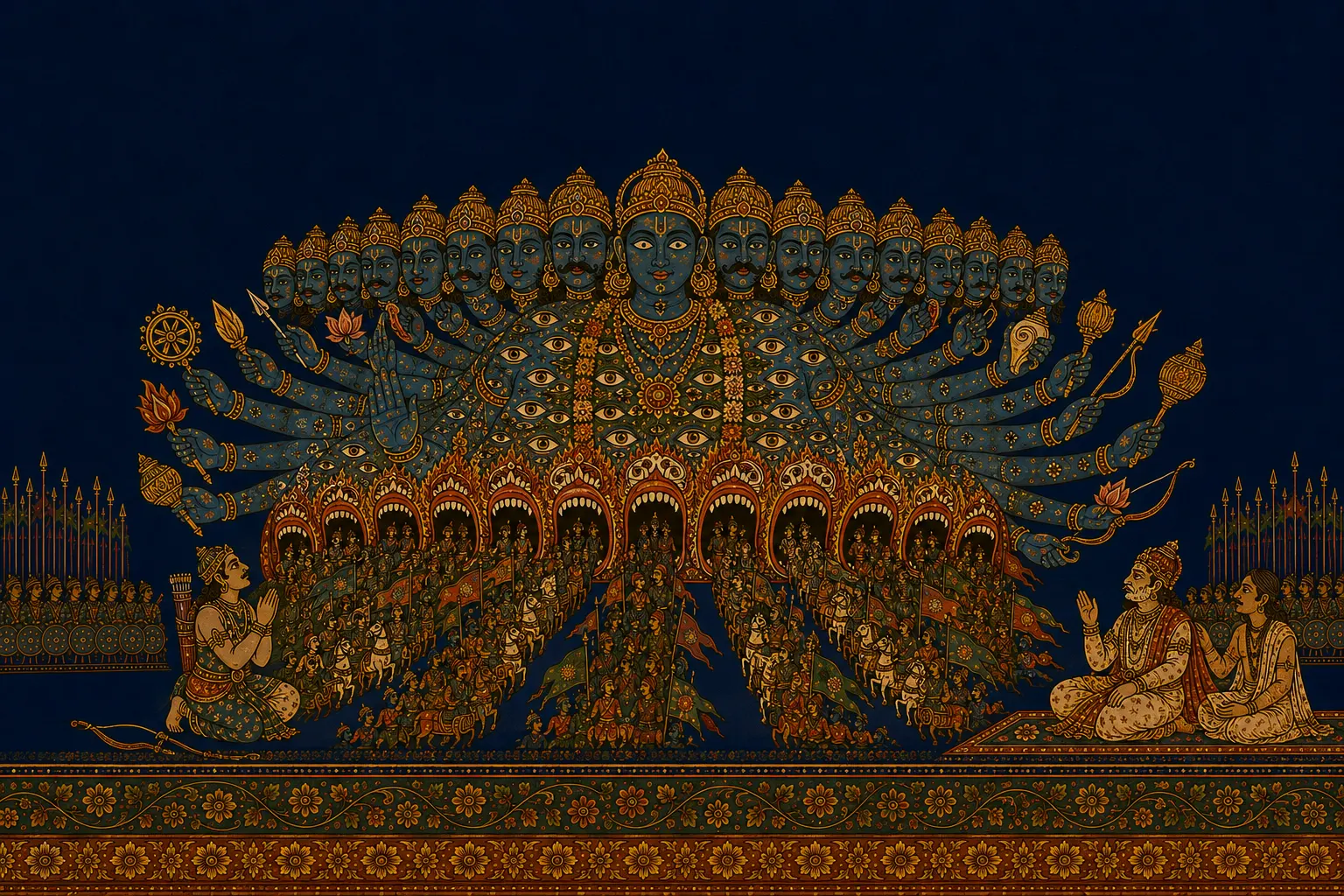
"My confusion has lifted, at least in part, from your words," Arjuna says. But now he wants more than words — he asks to see, with his own eyes, the sovereign, cosmic form Krishna has only described so far. "Show me that majestic, universal shape."

Krishna agrees — but warns him: ordinary sight cannot hold it. He grants Arjuna a divine eye for the purpose.

Sanjaya describes it

The first description does not come in Arjuna's voice. It comes from Sanjaya, still narrating to the same blind king, straining for words: countless mouths, countless eyes, countless raised weapons and ornaments, a single boundless body holding the whole moving world within it.

"If the light of a thousand suns blazed out in the sky at once," Sanjaya says, "it might come close to the glow of that form." Arjuna sees in it all the gods, all beings, the sages and the serpents — a form with no beginning, no middle, no end.

Terror

Then the vision turns terrible. The warriors of both armies are rushing headlong into the form's blazing mouths, crushed there — Bhishma, Drona, Karna, the sons of Dhritarashtra, all caught between its teeth.

Arjuna, trembling, asks who this is. "I am Time," Krishna answers, "grown vast, come to destroy the worlds." "Even without you," he adds, "these men will not survive. You are only to be the instrument of what has already been decided — so rise, and fight."

The apology

Overwhelmed, Arjuna begins begging forgiveness for every familiarity he has ever taken — for calling Krishna "friend" and "companion," for the years they ate together, rested together, joked as equals — alone, or in a full assembly — never knowing whom he was speaking to.

He praises the form, and then, like a frightened child pleading with a parent, asks to see the familiar four-armed shape again, and then the human one.

The gentler form, and the point

Krishna withdraws the cosmic form and shows Arjuna his familiar, gentle shape once more. "This form," he says, "no one has seen before you."

It is not reached through study of the Vedas, or austerity, or charity, or sacrifice. It is seen, truly known, and entered only through the devotion given to him — and to no one else.

Note: The line often quoted as "Now I am become Death, the destroyer of worlds" is J. Robert Oppenheimer's rendering; the Sanskrit of verse 11.32 says *kalo 'smi*, "I am Time," with "world-destroying" describing its work. Arjuna sees the form only with a sight Krishna grants him, not with his own eyes. The first and longest description of it is given by Sanjaya, not by Arjuna.

Source: Mahabharata — Bhishma Parva, The Universal Form

Now — how much stayed with you?

What happened?

What does Arjuna ask for, and what does Krishna give him?

  • He asks for leave from the war; Krishna refuses
  • He asks for the next teaching; Krishna begins Chapter 12
  • He asks Krishna to draw the chariot back
  • He asks to see with his own eyes the sovereign, cosmic form Krishna has been describing; Krishna says ordinary sight cannot take it in, and grants Arjuna a divine eye
Read the whole story — Arjuna asks to see

The teaching has cleared Arjuna's confusion, and he wants more than words.

Krishna agrees — but says that ordinary sight cannot take it in.

So he grants Arjuna a divine eye for the purpose.

Fact

In whose voice does the first extended description of the universal form come?

  • Sanjaya's
  • Arjuna's
  • Krishna's
  • Vyasa's
Read the whole story — Sanjaya describes it

The first description does not come from Arjuna — it comes from Sanjaya, struggling for words.

Countless mouths and eyes, countless raised weapons, a single boundless body in which the whole moving world is gathered.

It is a reminder that the reader too is seeing all of this through Sanjaya.

Riddle

Sanjaya says: if the light of this many blazed in the sky at once, it might resemble the splendour of that form. This many what?

  • A hundred suns
  • Ten suns
  • A thousand suns
  • Countless, with no number
Read the whole story — A thousand suns

"If the light of a thousand suns were to blaze in the sky at once" — it is a simile for radiance, not a scientific prediction.

Arjuna sees in the form all the gods, all beings, the sages and serpents, with no beginning, middle or end.

Then the vision turns terrible.

Who said it?

"I am Time, grown vast, come forth to destroy the worlds" — who says this?

  • Sanjaya
  • Krishna
  • Arjuna
  • Dhritarashtra
Read the whole story — "I am Time"

In the vision, the warriors of both armies are rushing into the form's flaming mouths and being ground to nothing — Bhishma, Drona, Karna, the sons of Dhritarashtra.

Arjuna, shaking, asks who this is.

Krishna answers that even without Arjuna these men will not survive; Arjuna is only to be the instrument of something already decided.

Fact

What does Arjuna ask forgiveness for?

  • For running from the war
  • For doubting Krishna
  • For halting the chariot
  • For every familiarity he has ever taken
Read the whole story — The apology

Overwhelmed, Arjuna asks forgiveness for the times they sat as equals, alone or in company.

He praises the form, and then, like a frightened child asking a parent, asks to see the ordinary four-armed shape, and then the human one, again.

Krishna draws the vision back in and returns to his familiar shape.

Who am I?

I am the eye that was given to Arjuna — without me he could not have seen the cosmic form. What am I?

  • The eye of knowledge, opened by study
  • The eye of devotion, opened by a lifetime of practice
  • The divine eye
  • Sanjaya's sight
Read the whole story — A borrowed sight

Krishna says plainly that ordinary sight cannot take this form in.

So what Arjuna sees, he sees not with his own eye but with a sight Krishna grants.

Arjuna does not see the universal form with ordinary vision; Krishna grants him divine sight for it.

Why is that?

Why does Krishna say, at the end of Chapter 11, that this form is not reached through the Vedas, austerity, gifts or sacrifice?

  • Because it is seen, truly known, and entered only through devotion that is given to him and to no one else
  • Because he regards all of these as worthless
  • Because this form is visible to no one
  • Because Arjuna had not performed austerity beforehand
Read the whole story — Only through exclusive devotion

Krishna draws the vision back in, returns to his familiar shape, and reassures the shaken Arjuna.

This form, he says, has not been seen by anyone before Arjuna.

And it is reached by no method — only through exclusive devotion (11.54).

The texts disagree

"Now I am become Death, the destroyer of worlds" — is this the Gita's own wording?

  • Yes, it is a direct translation of verse 11.32
  • Yes, Krishna uses the word "Death"
  • No
  • No
Read the whole story — Time, not Death

Oppenheimer quoted the line in that English form after the Trinity test, and that form became famous.

But "Time" means the process that carries everything away with it.

And the first, longest description of this vision is given by Sanjaya, not by Arjuna.

Put it in order

What is the correct order of events in Chapter 11?

  • Krishna returns to his gentle form → Arjuna asks for the divine eye → "I am Time" → terror
  • Arjuna asks to see the cosmic form → Krishna grants a divine eye → Sanjaya describes it (a thousand suns) → the vision turns terrible, "I am Time" → Arjuna apologises and begs for the gentle form → Krishna returns, "only through exclusive devotion"
  • Sanjaya describes it → Arjuna apologises → Krishna grants a divine eye → "I am Time"
  • "I am Time" → Arjuna asks to see → Krishna returns → terror
Read the whole story — From request to terror to reassurance

The chapter opens on a request and closes on a reassurance.

In between is the most terrible scene — warriors pouring into the mouths, and Krishna's "I am Time."

And all the while, the reader is seeing it through Sanjaya, narrating to the blind king.

Later tradition

"Arjuna sees the universal form with his normal eyes" — is this right?

  • Yes, Krishna gives him nothing
  • No
  • Yes, anyone standing there could have seen it
  • No
Read the whole story — Given the vision, not the sight

11.8: "you cannot see me with this, your own eye."

So Krishna: "I give you a divine eye."

It is Chapter 11's most overlooked point, and Sanjaya's description underlines it further.