Chapter 8

Ahiravana

Vibhishana came in and put everyone to sleep — and he was not Vibhishana at all

A familiar face in the night

It was a night in the middle of the war. Rama and Lakshmana were asleep, with vanaras on watch all round.

Then Vibhishana came in.

The guards did not stop him — why would they? He was one of their own.

But the one who went in was not Vibhishana. It was Ahiravana, Ravana's brother, king of Patala, who knew maya.

He recited a mantra, and sleep came down on the whole vanara army — deep, like unconsciousness. The guards fell where they stood.

Then he lifted the sleeping Rama and Lakshmana, and went down into the earth.

Morning, and two empty places

In the morning Hanuman's eyes opened.

Vanaras lay everywhere, slowly waking. And in the middle there were two empty places.

Vibhishana came running — the real Vibhishana.

"That was not me," he said. "That is my brother Ahiravana. He has taken them to Patala, and there he will sacrifice them — before his goddess."

Hanuman asked nothing. He asked only one thing: "Which way?"

At the gate of Patala, a guard

At the gate of Patala stood a vanara — half vanara, half fish.

"You cannot go further," he said.

"Move," said Hanuman.

"I cannot. I am the guard here. My name is Makardhwaja."

They fought. And as they fought Hanuman felt something odd — the young one was not losing.

"Who is your father?"

"My father's name is Hanuman," he said. "I have never seen him. They say that after burning Lanka, when he was cooling himself in the sea, a drop of his sweat was swallowed by a fish — and I came from it."

Hanuman had nothing to say.

Five lamps, five directions

Inside, Ahiravana had set Rama and Lakshmana before the goddess. The preparations for the sacrifice were done.

Hanuman looked around and understood where the real lock was.

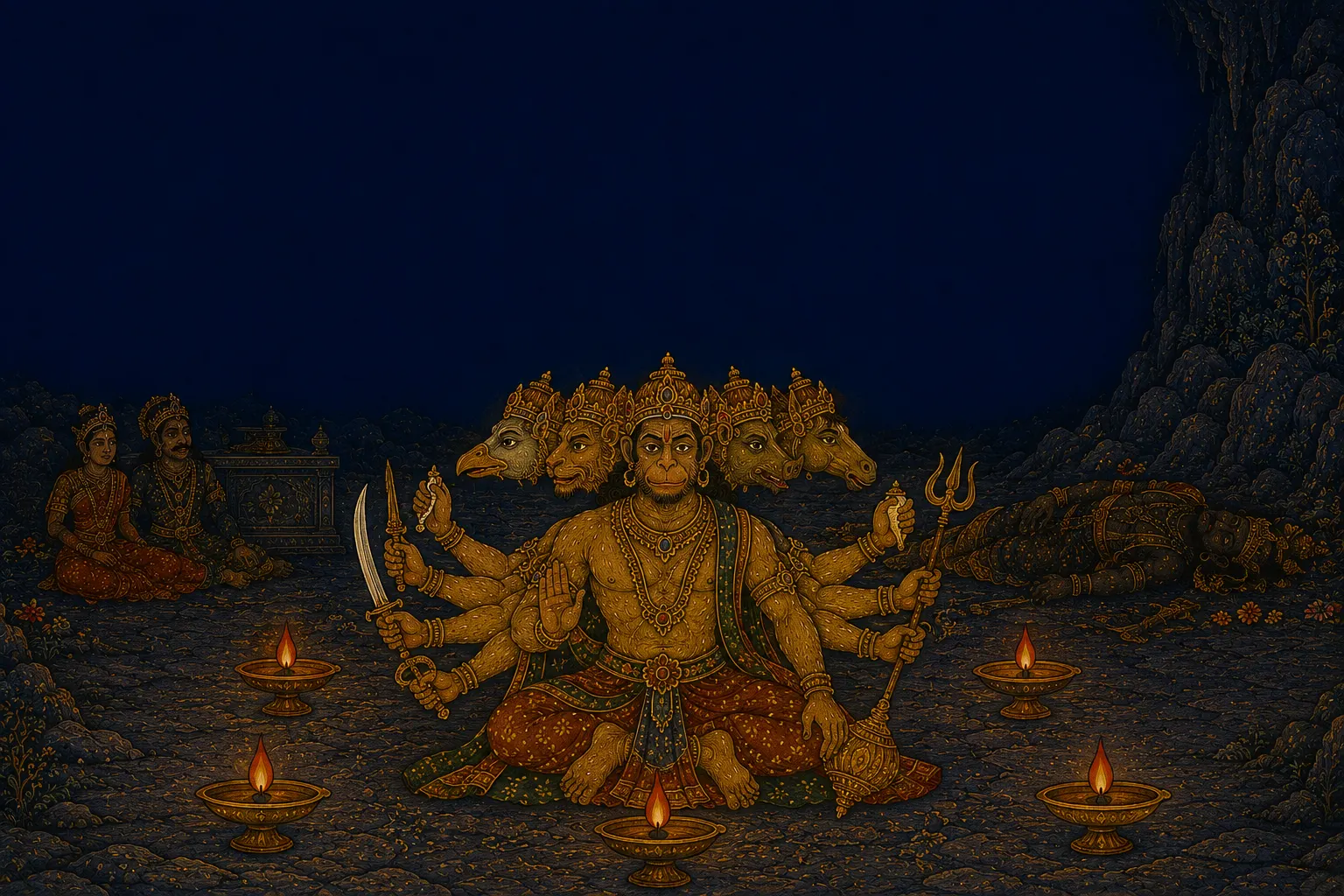
Five lamps were burning — in five different directions. And Ahiravana's life was in them. Only if all five went out at once would he die. If even one was left, he would stand up again.

Five lamps, five directions, and one body.

Five faces

Then Hanuman took the form he had never taken before and never took again.

Five faces — one his own, and four more: Narasimha, Garuda, Varaha and Hayagriva. Each face towards one direction.

And all five, in the same instant, together, put out all five lamps.

Ahiravana fell.

Two shoulders, two riders

Hanuman untied them. Rama sat on one shoulder, Lakshmana on the other.

On his way out he saw Makardhwaja still standing there.

Rama said, "He will be king of Patala now."

And Hanuman looked at his son for the first and last time, said nothing, and went upward.

Note: This whole chapter is outside the Valmiki Ramayana. Ahiravana — or Mahiravana — Patala, Makardhwaja and the five-faced form: none of it is found in Valmiki. The story is found in the fifteenth-century Bengali Krittivasa Ramayana, and is also told in later texts such as the Ananda Ramayana, the Bhavartha Ramayana and the Parashara Samhita. The traditions do not agree on the name, and both are recorded here. The statues and images of the five-faced Hanuman that are most common today have their root in this story — which is to say the most extraordinary-looking form of Hanuman does not come from the original Ramayana.

Source: from several texts, Ahiravana

Now — how much stayed with you?

Later tradition

Where does this whole episode of Ahiravana and Patala come from?

  • From the Valmiki Ramayana's Yuddha Kanda
  • Not in Valmiki; it comes from the Bengali Krittivasa Ramayana and some other later texts
  • From the Mahabharata
  • From the Sundara Kanda
Read the whole story — A story that is not in Valmiki

Ahiravana — called Mahiravana in some places — is not found in the Valmiki Ramayana.

The story is found in the fifteenth-century Bengali Krittivasa Ramayana, and is also told in later texts such as the Ananda Ramayana, the Bhavartha Ramayana and the Parashara Samhita.

Which is why this chapter has a different colour — it has maya, an underworld, a life kept elsewhere, five faces, none of which sits easily with Valmiki's plain manner of telling. This gatha keeps it, but with the label on.

Why is that?

Why did Ahiravana take Vibhishana's form?

  • Because Vibhishana was on their own side, so the guards would not stop him
  • Because he wanted revenge on Vibhishana
  • Because he could take no other form
  • Because Rama would not meet anyone but Vibhishana
Read the whole story — A breach made in trust

The whole vanara army was on watch, and Ahiravana still got right inside — not because the watch was weak, but because he chose the one face nobody questions.

That is the most frightening part of the story: the security was not broken, it was used.

Which is why the first thing the real Vibhishana had to say in the morning was that it had not been him.

Who am I?

I am half vanara, half fish. I kept the gate of Patala, and the one I was fighting turned out to be my own father. Who am I?

  • Makardhwaja
  • Angada
  • Nala
  • Sushena
Read the whole story — A son his father did not even know about

By the story, after burning Lanka Hanuman was cooling the fire of his tail in the sea, and a drop of his sweat was swallowed by a fish — Makardhwaja came from that.

This episode is not in Valmiki either; it comes from the same later texts the Ahiravana story comes from.

It is the one place in this whole gatha where anything of Hanuman's own family appears — and it is a son whose first meeting with him is a fight.

What happened?

What was necessary in order to kill Ahiravana?

  • Cutting off his head
  • Bringing him out of Patala
  • Breaking the image of the goddess
  • Putting out five lamps burning in five different directions, all in one instant
Read the whole story — A life that was not in the body

This is a familiar shape in the storytelling tradition: a demon's life is not in his body but hidden elsewhere, and until that place is found he does not die.

Here the condition is harder still — five lamps, five directions, and all of them must go out together. If one is left, all of it is wasted.

That condition determines the whole build of this chapter, and out of it comes the form this story is best known for.

Fact

Which are the five faces of the five-faced Hanuman?

  • Hanuman, Rama, Lakshmana, Bharata, Shatrughna
  • Hanuman, Narasimha, Garuda, Varaha and Hayagriva
  • Hanuman, Shiva, Brahma, Vishnu and Indra
  • All five faces were Hanuman's own
Read the whole story — Five directions, five faces

This form did not come as decoration — it was the direct solution to the problem of how one body reaches five directions at once.

Statues and images of the five-faced Hanuman are very common today, and their root is this story.

Which is to say the most extraordinary-looking form of Hanuman does not come from Valmiki but from this later tradition.

Why is that?

Why did Hanuman have to take the five-faced form?

  • So that Ahiravana would be frightened
  • So that he could please the goddess
  • So that he could lift both Rama and Lakshmana together
  • Because all five lamps had to be put out in the same instant, and one mouth could not do it
Read the whole story — A form that came out of a problem

The cleanest thing about this story is that the form does not come first, the problem does.

The condition was five lamps, one instant. The solution was five faces, each towards its own direction.

This keeps returning in the gatha: every great power of Hanuman's comes out in answer to some difficulty, not for display. At sea he got smaller; here he became five.

Riddle

I was burning, but I was not burning for light. Putting me out was the same as killing a man — and putting me out alone was useless. What am I?

  • The fire in the ashoka grove
  • Hanuman's tail
  • A sacrificial fire
  • One of the five lamps
Read the whole story — The condition for putting them out

The key to the riddle is in "putting me out alone was useless" — that was the real difficulty of this story.

If they had been put out one at a time, the lamps still burning would have set Ahiravana on his feet again.

Which is why this fight was not one of strength but of coordination — and that need is what produced the five-faced form.

What happened?

After Ahiravana was killed, what became of Makardhwaja?

  • Hanuman took him up with him
  • He was punished
  • Rama made him king of Patala
  • He joined Rama in the war
Read the whole story — One meeting, and that is all

Makardhwaja appears only in this chapter of the whole gatha — first as a guard, then as a son, and then as a king.

There is no emotional scene between Hanuman and him. There was a fight, there was a recognition, and then the work moved on.

A large truth of this gatha hides in that silence: there is very little in Hanuman's life that is his own. Even his son is met on the road, and left on the road.

Put it in order

Which is the right order of the events in this chapter?

  • Ahiravana coming in Vibhishana's form → sleep on the army → the carrying off of Rama and Lakshmana → the fight with Makardhwaja → the five lamps → the five-faced form
  • The five lamps → Ahiravana coming → Makardhwaja → the sleep
  • The fight with Makardhwaja → Ahiravana coming → the carrying off → the sleep
  • The sleep → the five-faced form → the carrying off → Vibhishana's form
Read the whole story — One night, and the world beneath it

All the events of this chapter happen in one night and the morning after it.

Worth noticing: nowhere in this whole episode does Hanuman win by strength alone — first he has to ask the way, then fight his own son, and at the end find the real lock.

The five-faced form is not the end of the story but its solution — and the solution only comes once the problem is fully understood.

The texts disagree

What is this demon's name?

  • Only Ahiravana, and no other name
  • Only Mahiravana
  • In different texts and traditions he is called both Ahiravana and Mahiravana
  • No name is given for him
Read the whole story — One story, two names

This is among those small disagreements that show these stories were not written in one place at one time.

Ahiravana in some places, Mahiravana in others — and in a few, the two are even said to be different characters.

Both names are recorded in this gatha and neither is settled as "the real one" — the same method used for the disagreements over counting in the Krishna-Leela.