
Chapter 1
Anjana's son
A child born out of a curse, and Indra wounded him on his first day
There was a condition hidden in the curse
Anjana was not a vanara to begin with. She was the apsara Punjikasthala, and she had made the mistake of breaking a sage's austerities. The sage cursed her — be born as a vanara.
But as with every curse, a way was left in this one: "When a son is born of your womb who is himself a portion of Shiva, only then will this form leave you."
Anjana became a vanara, married the vanara Kesari, and then went up to a mountain top and sat down to her own austerities — not to complete the terms of the curse, but for the son she wanted.
"I want a son," she said to Vayu, who blew across that mountain. "One who never loses."
Vayu gave his word
Vayu stopped. "Your austerity will not go for nothing. The son you get will be mine as well — no less than me in strength."
At that same time, far off in Ayodhya, Dasharatha was performing the putrakameshti, and a drop of the payasam from that fire was carried on the wind to Anjana. Anjana took it.
She conceived.
The birth, and a leap at the sun
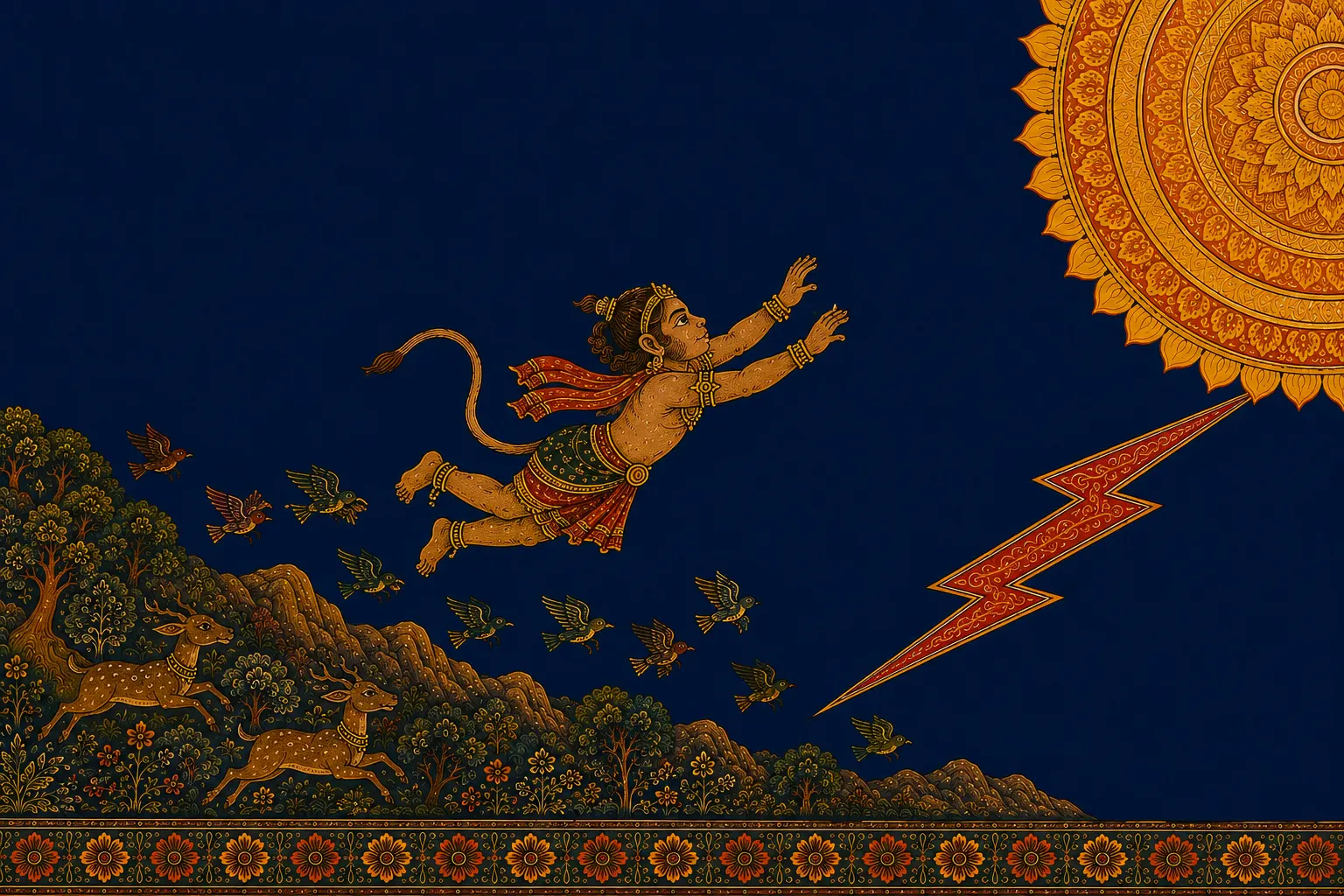
The son was born — a red face, a body like copper, and a strength he did not yet know he had. Morning came, the sun rose, and the infant saw that shining ball.
He took it for fruit.
Without thinking he leapt — up into the sky, straight at the sun. The tops of the trees fell away behind him, the clouds fell away, and the child went on through the air until he was near the sun.
The gods were watching from the sky. Nobody could see how this infant was going to stop.
Indra's thunderbolt
Rahu had come out that day to swallow the sun, and he took this flying child for a rival. At Rahu's call Indra arrived.
"Stop!" Indra roared. The child did not stop — the sun was still out of his reach, and getting to it was still to be done.
Indra raised the thunderbolt and threw it. It struck the child on the left jaw. The child began to fall out of the sky — and with that fall began everything that came afterwards.
Vayu's anger, and the world stopped breathing
Vayu saw his son falling. He caught him, took him into a cave — and then, in anger, drew the air out of the whole world.
Nowhere was anyone breathing. Trees still, rivers still, every living thing gasping. The gods understood that this anger would not settle without a boon.
"We are at fault," they said to Vayu. "Give your son back. We will make him such that nobody can ever hurt him again."
Two boons
The gods came forward one at a time. Brahma gave the first — "No weapon will kill him." Indra gave the second — "His death will come only by his own wish, at nobody else's hand."
The child's jaw — *hanu* — had been broken by that thunderbolt, and from that breaking came his name: Hanuman.
Vayu was calmed. The air came back. The world breathed again — and a child was now living whom no weapon could touch, and who could die only when he chose to.
A mischief that went a long way
After the boons the child Hanuman became fearless — so fearless that no weapon could touch him at all. He began scattering the materials of sacrifice in the hermitages, turning over the sages' water-pots, and jumping into the sacrificial fire to find that it could not burn him either.
One day a sage ran out of patience. He tried everything to stop the child — scolding him, reasoning with him — but the fearless boy would not be moved.
"You are so proud of your strength," the sage said. "Then hear this — you will forget it. Until somebody reminds you, you will not know yourself what you can do."
The curse took.
The strength was the same now, but not the memory of it.
The child Hanuman grew up — from fearless to quiet, from mischievous to silent — and unaware of his own strength.
Note: The birth, the leap at the sun, the thunderbolt and the boons — this whole episode comes in the Valmiki Ramayana at Kishkindha Kanda, sarga 66, in Jambavan's telling, and not in the Uttara Kanda as was earlier assumed. The curse of forgetting is in the Uttara Kanda, and in the Ramayana's own story it is compressed into a single line — there it is only the background to the crossing of the sea. Here that same event is the centre of Hanuman's own story.
Source: from several texts, Anjana's son