Chapter 5

On purpose

He was not captured. He chose to be captured

Wrecking the grove, deliberately

Sita had been found. The chudamani had been given. The work was done — he could have gone straight back.

Hanuman did not go back.

He began tearing up the trees of the ashoka grove — one, then another, then the whole garden. He broke the ponds, brought down walls, and made so much noise that the sleeping city woke.

This was not anger. It was a reckoning.

*If I go quietly back, all we will know is where Sita is. But we also need to know how large Ravana's army is, what he is like himself, and who in his court can speak against him. I will have to see all of that from inside.*

*And there is only one way inside — to be caught.*

One at a time, and then Indrajit

Ravana sent guards first. Then commanders. Then his own son Akshayakumara.

Nobody came back.

Then Indrajit came — the one who fought hidden in the clouds. And he used the one thing there was no answer to: the brahmastra.

Hanuman was bound and fell to the ground.

A binding that slackened by itself

Then something strange happened.

The hold of the brahmastra began to loosen of itself — because Brahma's boon was already Hanuman's, and this weapon could not keep him bound for long.

Hanuman felt it.

And he stopped moving.

*If I get free now, who will see the court? Who will tell Ravana what Rama says?*

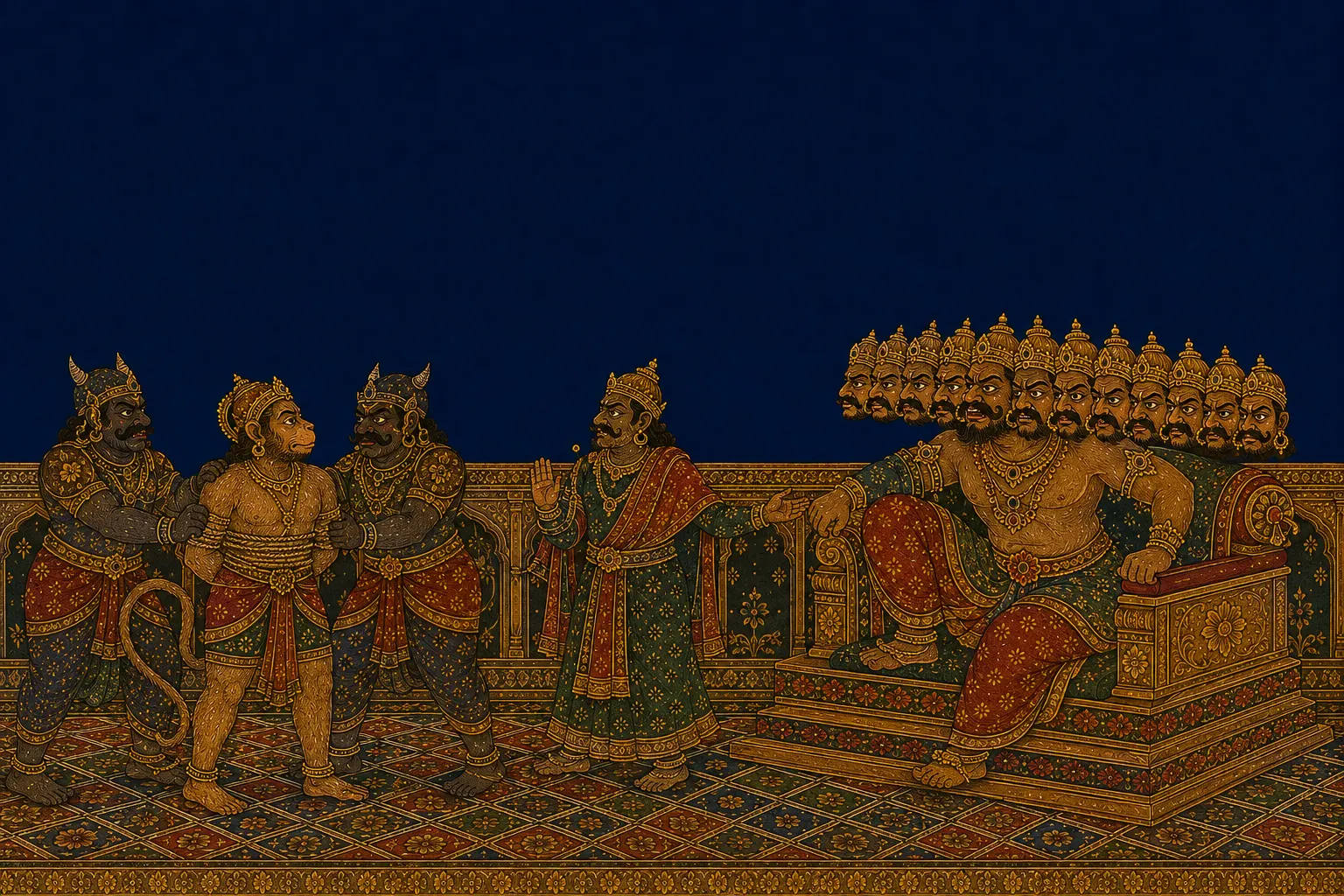
The demons tied him with ropes and dragged him towards the court. They thought they were taking a prisoner. They were in fact delivering a messenger exactly where he wanted to go.

The court

Ravana was on the throne — ten heads, twenty arms, and the swagger of a man who has lost to nobody.

Hanuman did not bow his head.

"I am Rama's messenger," he said. "Give Sita back. What has happened will be forgotten. And if you do not — this city, this army, and you, none of it will remain."

Silence fell in the court. Ravana's eyes went red.

"Kill him."

Then a voice rose — Vibhishana's.

"No. A messenger is not killed. That is the rule, and a king who breaks it is not called a king. Punish him, whatever you like — but do not kill him."

Ravana stopped. Then he laughed.

"Very well. A monkey is very fond of his tail. Set fire to it — and take him round the whole city, so that everyone sees."

The tail, and a fire that did not burn

They wound cloth round the tail, poured oil, and set it alight.

The fire burned — but it did not burn Hanuman. Far off in the ashoka grove Sita had prayed to the fire, and it went cold for him.

Hanuman made himself small, the bindings slackened, and he was free.

Then he began leaping roof to roof — and the burning tail left fire on every roof. Golden Lanka went up.

And then a fear

Reaching the shore, he put the tail out and looked back.

The whole city was burning.

And then the ground went from under him.

*The ashoka grove is in that same city. What have I done? The one I came to save — have I…*

He stood there shaking, until a voice came from the sky and he was told that Sita was safe.

Only then did he take a breath, and turn his face north for the return.

Note: The court scene, Vibhishana stopping the killing of a messenger, the tail set alight and the burning of Lanka are all in the Valmiki Ramayana's Sundara Kanda. So is the brahmastra's hold slackening of itself and Hanuman staying bound regardless. But coiling the tail into a seat and sitting higher than Ravana's throne is not found in Valmiki — it comes from later tradition and folk tales, however much it is now the most repeated scene of all.

Source: from several texts, On purpose

Now — how much stayed with you?

Why is that?

After Sita had been found, why did Hanuman wreck the ashoka grove instead of going quietly back?

  • Because seeing Sita's condition made him angry
  • Because he wanted to be caught, so that he could see Ravana and his court from inside
  • Because Sita had told him to
  • Because he could not find the way
Read the whole story — A messenger's real work

Hanuman's task was not only to find Sita — he also had to see what the army was that they would have to fight.

There was no other way to do it. Lanka's court was not a place anyone could reach by stealth.

Which is why this chapter is called what it is. What looks from outside like being taken prisoner was, from inside, a choice.

Who said it?

"A messenger is not killed. Punish him, whatever you like — but do not kill him." — who said this in open court?

  • Vibhishana
  • Indrajit
  • Mandodari
  • Akshayakumara
Read the whole story — The voice that later changes sides

Vibhishana's argument was not sentimental — he argued the rule: a messenger brings a message, he is not an enemy, and killing him diminishes a king.

Ravana accepted it, but in his own way — he chose humiliation instead of death.

This same Vibhishana later leaves Ravana and goes to Rama, and this court scene is its first sound.

Fact

What punishment did Ravana give Hanuman in place of death?

  • Threw him in prison
  • Had him thrown into the sea
  • Had him whipped
  • Ordered his tail set on fire and him taken round the whole city
Read the whole story — A punishment of humiliation

Ravana chose what a king chooses for a spectacle — not death, but a punishment the whole city would watch.

The thinking behind choosing the tail was the same: a vanara's mark, and a blow to exactly that.

And that decision cost him dearly. The fire he meant to humiliate Hanuman with is the fire that burned his city.

Why is that?

Even after the brahmastra's binding slackened by itself, why did Hanuman stay bound?

  • Because getting free would have kept him from the court, and there would have been nobody to bring Rama's message to Ravana
  • Because he really could not move
  • Because he was unconscious
  • Because Indrajit had a second weapon aimed
Read the whole story — A binding that was really a ride

Brahma's boon was already Hanuman's, so the brahmastra could not hold him for long.

Hanuman understood that — and still did not move, because his purpose at that moment was not to get free but to get inside.

The demons dragged him exactly where he wanted to go. That is the largest piece of cunning in the whole episode.

What happened?

After burning Lanka and reaching the shore, what happened to Hanuman?

  • He rejoiced and leapt away at once
  • He was seized by the fear that Sita might have burned in the fire too, and stood there shaking
  • He went back into Lanka
  • He challenged Ravana
Read the whole story — The fear right after the victory

This is the most human part of the episode — the work was done, the city had burned, and just then he was frightened by his own victory.

The thought came to him when nothing could be done. The fire was already lit.

Then he was told Sita was safe, and only then could he go back. In this gatha the fear is recorded as fully as the strength.

Who am I?

I was Ravana's son. My father sent me to fight that monkey, and I did not come back. After me my elder brother went, with the brahmastra. Who am I?

  • Indrajit
  • Akshayakumara
  • Vibhishana
  • Kumbhakarna
Read the whole story — Sent out, and did not return

Ravana sent guards first, then commanders, and when nobody came back he sent his own son Akshayakumara.

Akshayakumara's death is the moment Ravana understood this was no ordinary monkey — and Indrajit was sent then.

So to bind Hanuman, Ravana had to spend both his greatest warrior and his greatest weapon.

Riddle

I was set on fire so that my owner would be shamed. But I spread that fire across the whole city, and the one shamed was the man who lit it. What am I?

  • Hanuman's tail
  • The brahmastra
  • The chudamani
  • The ashoka tree
Read the whole story — A punishment that became a weapon

Ravana's intent was plain — a spectacle. Take him round the whole city, let everyone see, and the monkey's swagger ends.

It went the other way. Hanuman leapt across the roofs with a burning tail, leaving fire on each one.

It is the largest irony in this gatha: Lanka burned in the very fire Ravana had lit himself.

Later tradition

"In the court Hanuman coiled his tail into a seat and sat higher than Ravana's throne" — where does this story come from?

  • From the Valmiki Ramayana's Sundara Kanda
  • From the Mahabharata
  • From later tradition and folk tales
  • From the story Sampati told
Read the whole story — The most famous scene, which is not in the original

Coiling the tail into a seat and sitting higher than Ravana — this scene comes up again and again in plays, paintings and serials, and almost everyone knows it.

But Valmiki's court scene is different: there Hanuman does not bow his head and delivers his message directly, and the seat does not come into it.

This gatha does not remove such stories — it simply says where each one is coming from. Being famous and being in the original text are two different things.

Fact

Why did the fire set to his tail not burn Hanuman?

  • Because he had dipped the tail in water
  • Because Brahma's boon included protection from fire
  • Because Indrajit stopped the fire
  • Because at Sita's prayer the fire went cold for him
Read the whole story — A prayer from far off

Sita was in the ashoka grove at the time, and she prayed to the fire not to burn the one who was doing so much for her.

This detail is what keeps the story from being one-sided — through the whole episode Sita is a prisoner, and she is also the one who saves.

And afterwards that same fire burns Lanka. One fire, two entirely different results.

Put it in order

Which is the right order of these events?

  • The brahmastra → wrecking the grove → the court → the tail set alight
  • Wrecking the grove → Akshayakumara's killing → the brahmastra → the court → Vibhishana's intervention → the tail set alight → the burning of Lanka
  • The court → wrecking the grove → the brahmastra → the burning of Lanka
  • The tail set alight → the court → the brahmastra → wrecking the grove
Read the whole story — A whole chain out of one decision

Every event in this chapter comes out of that first decision — to be caught.

If the grove had not been wrecked the army would not have come; without the army no Indrajit; without Indrajit no sight of the court; without the court, Vibhishana's voice would never have been heard.

And if the tail had not been set alight, Lanka would not have burned either. Every punishment of Ravana's worked against him.