Chapter 9

What was left

The greatest boon he was given was that he stayed, while everyone else went

What he asked for

After the coronation, Rama told Hanuman to ask for something.

Gold was on offer, a kingdom was on offer, whatever he wanted could be had.

Hanuman said:

"All I want is this — that as long as your story is told on this earth, I stay here. I want to listen to it."

Rama was quiet for a while. It was an easy boon to give and the heaviest one to carry — because it meant Hanuman would watch everyone go.

Then he said yes.

And then everyone went

Time passed.

Sita went into the earth. Rama walked towards the Sarayu, and Lakshmana had gone before him. Bharata, Shatrughna, Sugriva, Angada, Jambavan — one by one, all of them went.

New kings came to Ayodhya. Then their sons. Then their sons.

And one vanara was left in the forests, who had known them all.

Much later, in a forest

This is from very much later. So much later that a different age was running by then, and a different war was about to happen.

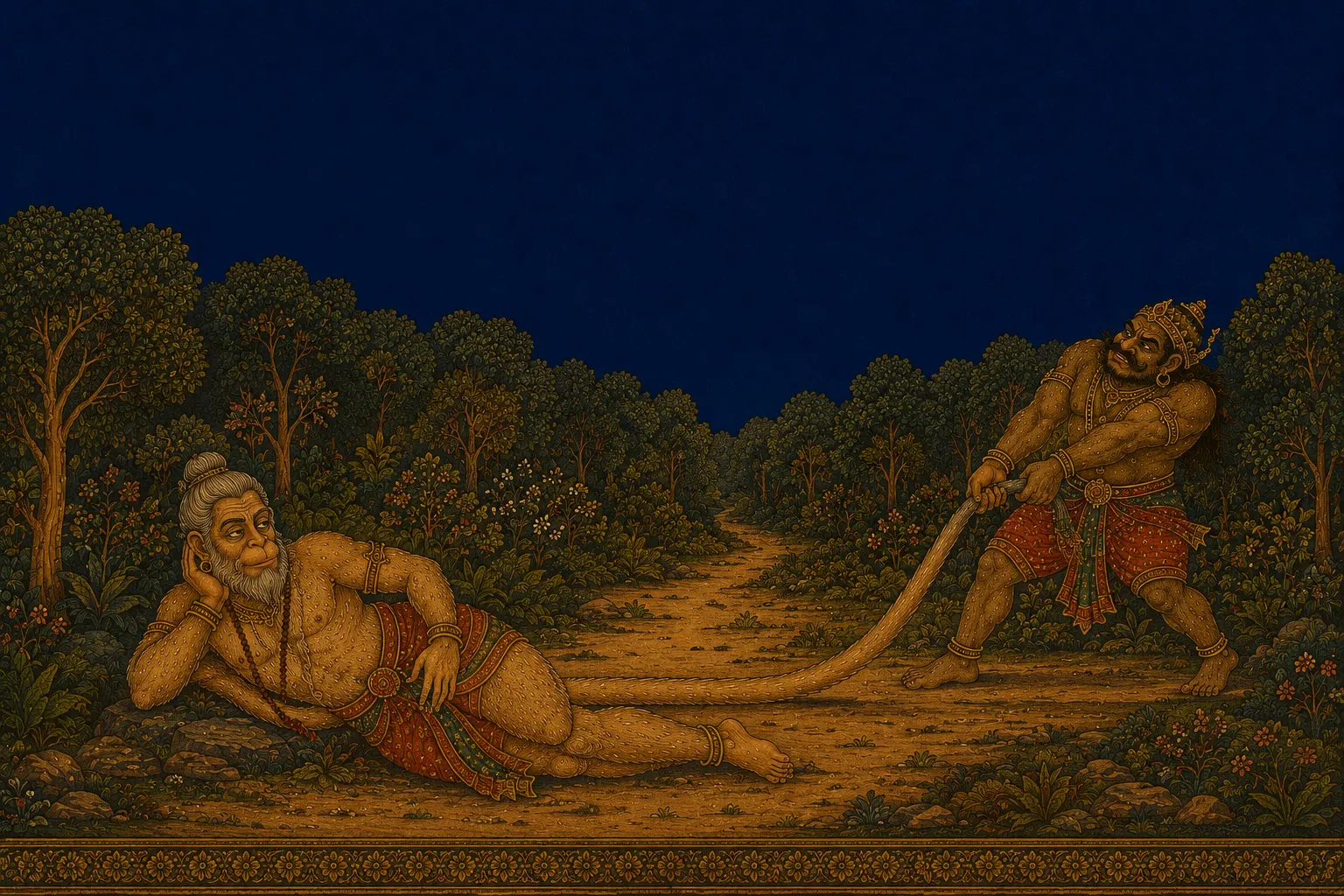
An old monkey was lying across a forest path. Weak, thin, and his tail stretched out right in the middle of the road.

A very strong man came that way and said, "Move your tail."

"I am old," the monkey said. "Move it yourself."

The man took hold of the tail and pulled. It did not shift. He put out his full strength — the strength with which he had beaten thousands.

The tail did not move at all.

And then he understood who he was standing in front of.

Two brothers, two ages

The man was Bhima — son of the wind. Which is to say the two of them were brothers, only born in different ages.

Hanuman gave him a blessing, and a promise as well: in the war that was coming, he would sit on the flag of Arjuna's chariot.

Then Bhima went on his way.

And Hanuman went on sitting there — in a world where he was himself a story now. The Rama he had carried on his own shoulders was the Rama whose story people now told, and not one of the tellers had ever seen him.

What he wrote, and wiped out

They say that once he wrote that story himself.

With his nails on rock, or on banana leaves — the story is told both ways.

And they say that when it was read, it stood even above Valmiki's work — because Hanuman had seen everything Valmiki had only heard.

Then Hanuman destroyed it — throwing it into the sea, or swallowing it.

When he was asked why, the only answer that came back was that he did not want his own work to cover over Valmiki's story.

He had seen it. But he did not let it grow larger than his own name.

And still

It is said that he never left.

That was the condition of the boon — for as long as Rama's story is told.

So tradition holds that wherever that story is being told, there is one listener in the room whom nobody counts.

Nobody sets out a seat for him.

Nobody calls his name.

But he is listening — to the very story he was in.

Note: The meeting of Bhima and Hanuman is in the Vana Parva of the Mahabharata — it is the one episode in this gatha that comes from the Mahabharata and not the Ramayana. The boon asked of Rama — that he remain for as long as Rama's story is told — is very firmly recorded in tradition, and the list of Chiranjivis comes separately from a later stotra; it is not right to treat the two as one claim. The Hanumad Ramayana, that is, the Ramayana he wrote himself and destroyed, is entirely later tradition — no source text for it has ever been identified, and the traditions do not agree with each other on how it was destroyed either.

Source: from several texts, What was left

Now — how much stayed with you?

Why is that?

What boon did Hanuman ask Rama for?

  • That for as long as Rama's story is told on this earth, he stay here and go on listening to it
  • That he be given a kingdom in Ayodhya
  • That he stay with Rama forever
  • That his lost strength be given back to him
Read the whole story — The strangest thing to ask for

Hanuman could have asked for anything — a kingdom, gold, a position. He asked for none of it.

He asked for something that is also, in a way, a sentence: to stay, while everyone else goes.

This is the last turn of the gatha. The man who had to be reminded of his own strength ended by asking for the work of remembering.

Who am I?

I am the son of the wind and Hanuman's brother — but we were born in different ages. In a forest, a tail would not lift for me. Who am I?

  • Arjuna
  • Yudhishthira
  • Bhima
  • Nakula
Read the whole story — The thread that ties two epics together

This is one of the very few places where the Ramayana and the Mahabharata meet directly — and this one character is what joins them.

The meeting was not the same thing for Hanuman as it was for Bhima. Bhima was meeting a story; Hanuman was meeting a brother.

He went on to promise that in the war he would be on the flag of Arjuna's chariot — which is why Arjuna is called Kapidhwaja.

Why is that?

Why did Hanuman take the form of an old, weak monkey in front of Bhima?

  • Because Bhima was proud of his strength, and this was the way to break that pride without a fight
  • Because he really had grown weak
  • Because he wanted to hide
  • Because he was afraid of Bhima
Read the whole story — A lesson given without a fight

Hanuman did not defeat Bhima. He simply put a tail in the road and refused to move it.

Bhima put out his full strength — the strength he was proud of — and it was not enough.

This scene is a particularly sweet one in this gatha: the man who could never keep his own strength in mind is now showing somebody else the limit of theirs.

Later tradition

"Hanuman wrote a Ramayana of his own and then destroyed it" — where does this story come from?

  • From the Uttara Kanda of the Valmiki Ramayana
  • From the Mahabharata
  • From the Ramcharitmanas
  • From no source text that can be identified; it is entirely later tradition
Read the whole story — The book nobody can find

The story is called the Hanumad Ramayana, and it is told very often — but no original text for it has ever been identified.

Tradition does not agree on how it was destroyed either: in some places he wrote it on rock with his nails and threw it into the sea, in others he wrote it on banana leaves and swallowed it.

It is recorded here the same way Ranchhod is recorded in the Krishna-Leela — the story is told, and it is said plainly that no text was found standing behind it.

What happened?

According to tradition, why did Hanuman destroy the Ramayana he had written?

  • Because there were mistakes in it
  • Because he did not want his own work to cover over Valmiki's story
  • Because Rama had told him to
  • Because it had been left unfinished
Read the whole story — What he wrote, and let go

According to the story Hanuman's work stood even above Valmiki's — and the reason was simple: he had seen with his own eyes everything Valmiki wrote from hearsay.

And that is exactly why he destroyed it, so that Valmiki's name would not be made smaller because of him.

There could be no better story for the last chapter of this gatha. The man whose whole story runs on other people reminding him wiped out his own greatest work himself.

Riddle

I saw everything a poet had only heard. I wrote it down too, and then wiped it out with my own hands — so that the poet's name would stand. Who am I?

  • Hanuman
  • Valmiki
  • Vyasa
  • Lava and Kusha
Read the whole story — The difference between seeing and hearing

That is the key to this riddle — Valmiki heard the story and wrote it, Hanuman lived it.

Tradition says this is why his work went deeper, and this is why he did not let it stand.

Worth noticing: this story makes Hanuman a poet as well, not only a warrior. And that poet is remembered for giving up his greatest work.

Fact

What class of beings does tradition place Hanuman in?

  • Among the avatars, in the list of Vishnu's ten
  • Among the Saptarishis
  • Among the Chiranjivis
  • Among the Dikpalas
Read the whole story — The ones who stayed

Chiranjivi is what those characters are called who do not end with an age. In tradition's list, Hanuman's name comes with Ashvatthama, Bali, Vyasa, Vibhishana, Kripacharya and Parashurama.

That list comes from a separate, later stotra — which is to say it is part of the praise, not part of the story.

But in Hanuman's case there is a root for it in the story too: his staying comes not from any list, but from the boon he asked Rama for.

Who said it?

"I am old. Move it yourself." — who said this, and to whom?

  • Bhima to Hanuman
  • Jambavan to Hanuman
  • Arjuna to Bhima
  • Hanuman to Bhima
Read the whole story — An answer that was a trap

Hanuman was not lying — he really was very old, by any measure at all.

What he did not mention was that age had made no difference to his strength.

Bhima did what any strong man would do — he pulled, to see. And his pride ended right there, without a word of sermon.

Why is that?

Why is this boon of Hanuman's held to be the heaviest one?

  • Because keeping it took a great deal of penance from him
  • Because it reduced his strength
  • Because Rama did not want to give it
  • Because it meant he would watch everyone he knew go
Read the whole story — The price of staying

From outside, this looks like the plainest boon of all — no kingdom, no gold, just to go on hearing a story.

But the other half of it is that Rama went, Sita went, Lakshmana went, Sugriva and Jambavan went — and he was left.

The meeting with Bhima shows this most clearly of all: he had arrived in a world where he was himself a story, and nobody was left alive who had seen him.

Put it in order

Which is the correct order of the events of this gatha?

  • Meeting Bhima → the burning of Lanka → asking for the boon → Sanjeevani
  • Asking for the boon → crossing the sea → Sanjeevani → meeting Bhima
  • Jambavan's reminding → crossing the sea → the burning of Lanka → Sanjeevani → asking for the boon → meeting Bhima
  • Sanjeevani → Jambavan's reminding → crossing the sea → meeting Bhima
Read the whole story — A whole life, in one line

This gatha begins with a child who does not know his own strength, and ends with an old man who knows it so well that he never needs to show it.

Everything in between was done for somebody else — for Rama, for Lakshmana, for Sita.

And what he asked for at the end was not for himself either: only to stay near the story he was in.