Chapter 7

The pearl necklace

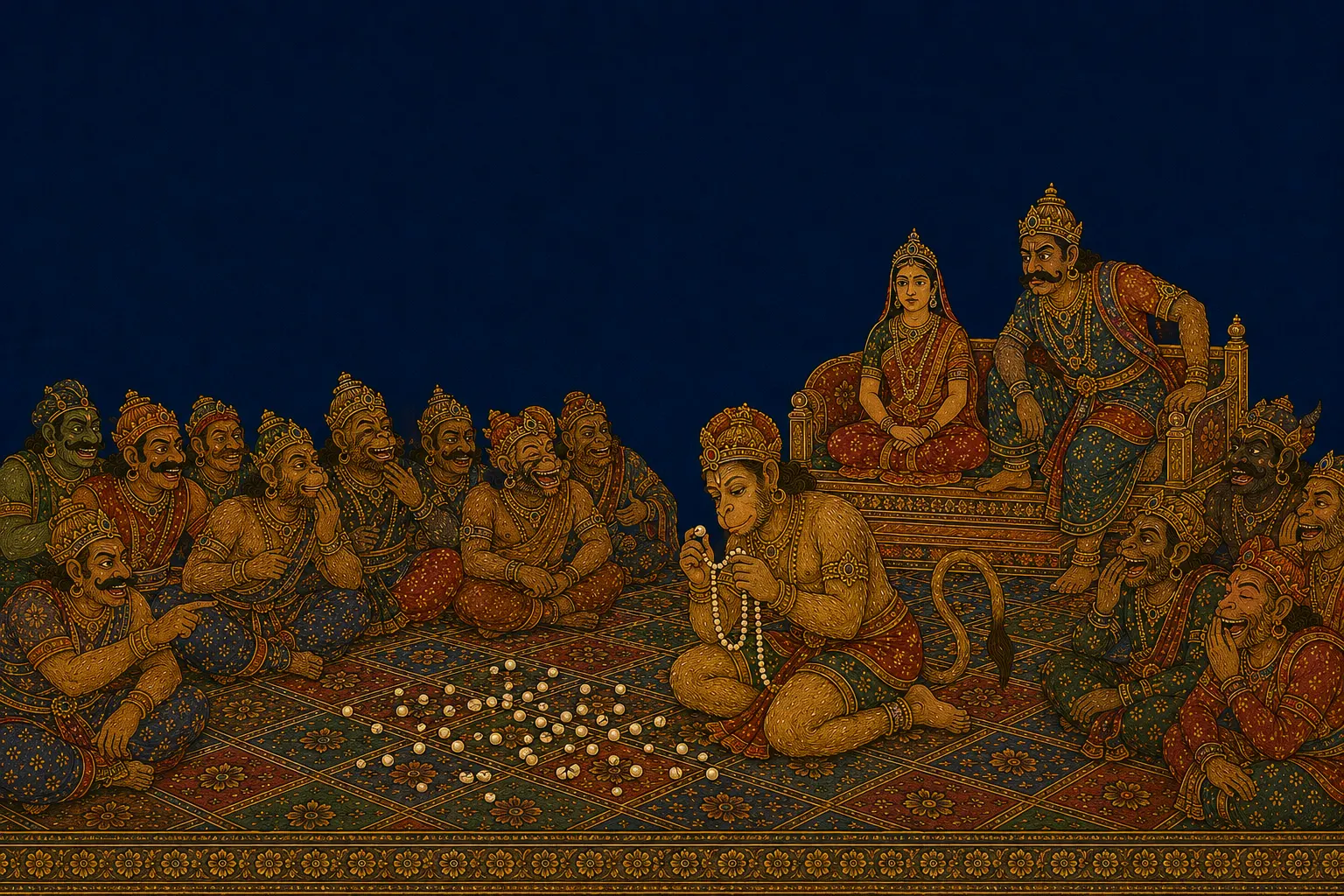
He broke the pearls one by one and threw them down, and the whole assembly laughed at him

A necklace that passed through three hands

The war was over. Ravana was dead. They had returned to Ayodhya and the coronation had been held.

Now came the day when whoever had done something was to be honoured for it. The hall was full — vanaras, rakshasas, ministers, people of the city. The crowd stood out beyond the doors.

Vibhishana set a necklace in front of Rama — from the treasury of Lanka, of pearls. Large, white, all alike, without a single flaw. The kind of pearls the sea takes years to make.

Rama touched it and passed it to Sita.

Sita put it round her neck.

And then she took it off

Everyone in the hall received something — gold, or land, or a post.

Then Sita took that same necklace from her neck.

The whole hall was watching to see whose it would be.

She held it out to Hanuman.

Hanuman took it in both hands, bowed his head, and moved aside and sat down.

One pearl at a time

He kept looking at the necklace. For a long time — long enough that the people sitting near him began to watch him.

Then he took one pearl between his fingers, broke it with his teeth, looked inside — and dropped it.

The pearl fell on the stone floor and rolled away. The sound of it was clear across the hall.

Then a second. Then a third.

Now everyone was watching in silence. Hanuman's face was unchanged — no hurry, no anger, only a man looking for something and not finding it.

He went on breaking them until broken pearls were scattered over the floor.

The assembly laughed

One person's laugh escaped first. Then two or three more.

"What does a monkey know about the worth of a pearl," somebody said from the back, and more laughter came on top of it.

"What are you doing?" somebody finally asked. "The mother has given you the necklace from her own neck, and you are breaking it and throwing it away?"

Hanuman lifted his head. There was no shame on his face at all.

"I am looking in each pearl to see whether Rama is inside it," he said. "He is not. Then what use is it to me? Anything without Rama in it is a stone to me."

There was a moment's silence. Then the hall laughed louder than before.

"So is he inside you, then?" somebody jeered.

The chest

Hanuman stood up.

He gave no answer, made no defence, did not even look at anyone.

He simply put both hands to his chest and tore it open.

The laughter stopped in an instant.

Inside, in his heart, Rama and Sita were seen sitting.

After that nobody said anything

Nobody in the hall spoke. The ones who had been laughing lowered their eyes.

Sita's eyes filled.

Rama rose from the throne, came down, and stood beside Hanuman.

And Hanuman stood there — uncomfortable, because now everyone was looking at him.

He had not done it to show anything. He had been asked a question, and this was the only answer he had.

Note: This chapter is entirely from later tradition — the pearl necklace, the broken pearls and the opened chest are not found in the Valmiki Ramayana. And one thing here is left open, which this gatha has not hidden: the source of the story is not settled either. Some sources connect it to the fifteenth-century Bengali Krittivasa Ramayana, some to the tradition of Tulsidas — but no firm location was found for it inside the Ramcharitmanas or in any old Sanskrit text. So no single claim has been settled as right here. The story is real; its address is uncertain.

Source: from several texts, The pearl necklace

Now — how much stayed with you?

Later tradition

Where does this whole episode of the pearl necklace and the opened chest come from?

  • It is not in the Valmiki Ramayana; it comes from later tradition, and the sources disagree about which
  • It is part of the Valmiki Ramayana's Yuddha Kanda
  • It comes from the Mahabharata
  • It is in the Kishkindha Kanda
Read the whole story — The best-loved story, on the least certain source

This is perhaps the most repeated Hanuman story in India — in paintings, in statues, in recitation, everywhere.

And it is nowhere in the Valmiki Ramayana. The original text has no mention of this necklace, these broken pearls, or this opened chest.

This gatha has not removed it, because it is a true part of the tradition. It has only said where it is coming from — and the next question says that even the "where" is not fully settled.

The texts disagree

What is the position on which text this story comes from?

  • It is certain that it comes from the Krittivasa Ramayana
  • It is certain that it comes from Tulsidas
  • The source is unsettled
  • The story is in no text at all and is entirely modern
Read the whole story — When the source itself is divided

In the research for this gatha the question stayed open, and it is recorded open. Some sources connect it to the fifteenth-century Bengali Krittivasa Ramayana; some directly to Tulsidas's tradition.

But no firm evidence was found for the episode inside the Ramcharitmanas, nor in any old Sanskrit text.

The honest answer is this: the story is real, its address uncertain. Rather than settling one claim as "right", this gatha keeps both — the same method used for the disagreement between the Harivamsha and the Bhagavata in the Krishna-Leela.

Why is that?

Why did Hanuman break the pearls of the necklace and throw them away?

  • Because he did not like the necklace
  • Because he was testing whether the pearls were genuine
  • Because he was looking for Rama in each pearl, and anything without Rama in it was a stone to him
  • Because Sita had told him to
Read the whole story — A strange measure

Hanuman's measure was not worth — the pearls were genuine, flawless, and everyone in the hall knew what they cost.

His question was a different one: is Rama in this. And the moment that question is asked, all the worth of the necklace stops meaning anything.

Which is why the hall laughed — they thought a monkey did not know worth. In fact Hanuman was not talking about worth at all.

Who said it?

"Anything without Rama in it is a stone to me." — who said this?

  • Sita
  • Vibhishana
  • Lakshmana
  • Hanuman
Read the whole story — An answer, not a defence

What is worth noticing is that Hanuman neither apologised nor hid what he had done.

He stated his measure directly — and that measure matched nobody else's in the hall.

Which is what makes this story so well loved: the devotion in it shows not through any rule or custom but through a strange stubbornness.

What happened?

"So is Rama inside you, then?" — what did Hanuman do in answer to that jeer?

  • He left the hall
  • He tore open his chest and showed them
  • He asked Rama to vouch for him
  • He gave no answer
Read the whole story — An answer without words

Hanuman speaks very little through this whole episode. His real answer is not an argument.

What is particular in the story is that he did not do it to display anything — he was asked, and he answered.

Which is why this scene has been painted more than any other. There is nothing left to say in it, only something to see.

Riddle

I was valuable, flawless, and had hung round a queen's neck. Even so a devotee broke me and threw me on the floor — not because I was false, but because I was empty. What am I?

  • The chudamani
  • A pearl from the necklace
  • Ravana's crown
  • The ring
Read the whole story — What being empty means

The key to this riddle is that there was no fault in the pearl — it was genuine, beautiful, expensive.

In Hanuman's eyes what it lacked was that there was nothing inside it. And by "something" he meant only one thing.

The whole story rests on that one inverted measure: the world asks what this is worth, and Hanuman asks who is in it.

Valmiki or tradition?

What did Hanuman receive after the war in the Valmiki Ramayana?

  • A pearl necklace, which he broke
  • Nothing; he received no honour in Valmiki
  • In Valmiki, Rama praises him again and again and embraces him, but the breaking of the pearls is not there
  • Only a kingdom
Read the whole story — The honour is there, the story is not

This distinction matters, or it will look as though Valmiki was stingy with Hanuman.

In Valmiki, Rama says a great deal in praise of Hanuman and embraces him — there is no shortage of honour.

Only this particular story of the pearls is not there. Later tradition turned that same honour into a scene, and the scene became more famous than the original text.

Why is that?

Why did the assembly laugh at Hanuman?

  • Because he had insulted Rama
  • Because he was standing in the wrong place
  • Because he had argued with Sita
  • Because everyone thought a vanara did not know the worth of something precious
Read the whole story — The misunderstanding that is the real subject

The hall saw what was visible — a vanara, and expensive pearls broken.

They did not ask why he was doing it. The jeer came first, the question afterwards.

Which is why this story is not only about devotion. It is also about a man who was underestimated again and again — first on the shore, when nobody said his name, and now in open assembly.

Who am I?

I had given that necklace. When it lay broken and scattered on the floor I still did not say one word — and at the end it was my eyes that filled. Who am I?

  • Mandodari
  • Sita
  • Kausalya
  • Trijata
Read the whole story — The one who said nothing

In that whole hall there was one person with the most right to complain — the necklace was hers.

And she was the one who stayed silent. She neither stopped him nor corrected him.

In this story Sita's silence matters as much as Hanuman's chest. The one who could understand had understood already.

Put it in order

Which is the right order of the events in this episode?

  • Hanuman tearing open his chest → receiving the necklace → breaking the pearls → the hall laughing
  • The hall laughing → receiving the necklace → breaking the pearls → the jeer
  • Sita giving the necklace → breaking the pearls → the hall laughing → "so is he inside you?" → the chest
  • Breaking the pearls → receiving the necklace → the chest → the laughing
Read the whole story — A scene that came out of a jeer

The most important thing in this whole episode is that Hanuman did not tear open his chest of his own accord — it was an answer, not an initiative.

If the hall had not jeered, the story would have ended at the breaking of the pearls.

Which is to say that the scene painted and shown more than any other today was in fact born out of somebody else's laughter.