
Chapter 4
Lanka at night
He searched the whole city, and Mother Sita was nowhere — that is the largest moment of this night
A woman standing at the gate
Night came. Hanuman made himself no bigger than a cat and went towards the wall.
Then somebody stood in front of him — the presiding spirit of Lanka, a woman keeping watch over the city.
"Thief," she said. "This city is mine."
She swung a mace. It struck. Hanuman staggered, and then hit her once with his left hand — a closed fist, without putting his full strength behind it.
She fell. And as she fell she began to laugh.
"Brahma told me," she said, "that the day a vanara defeats you, know that the demons' time is up. Go. That day has come."
A sleeping city
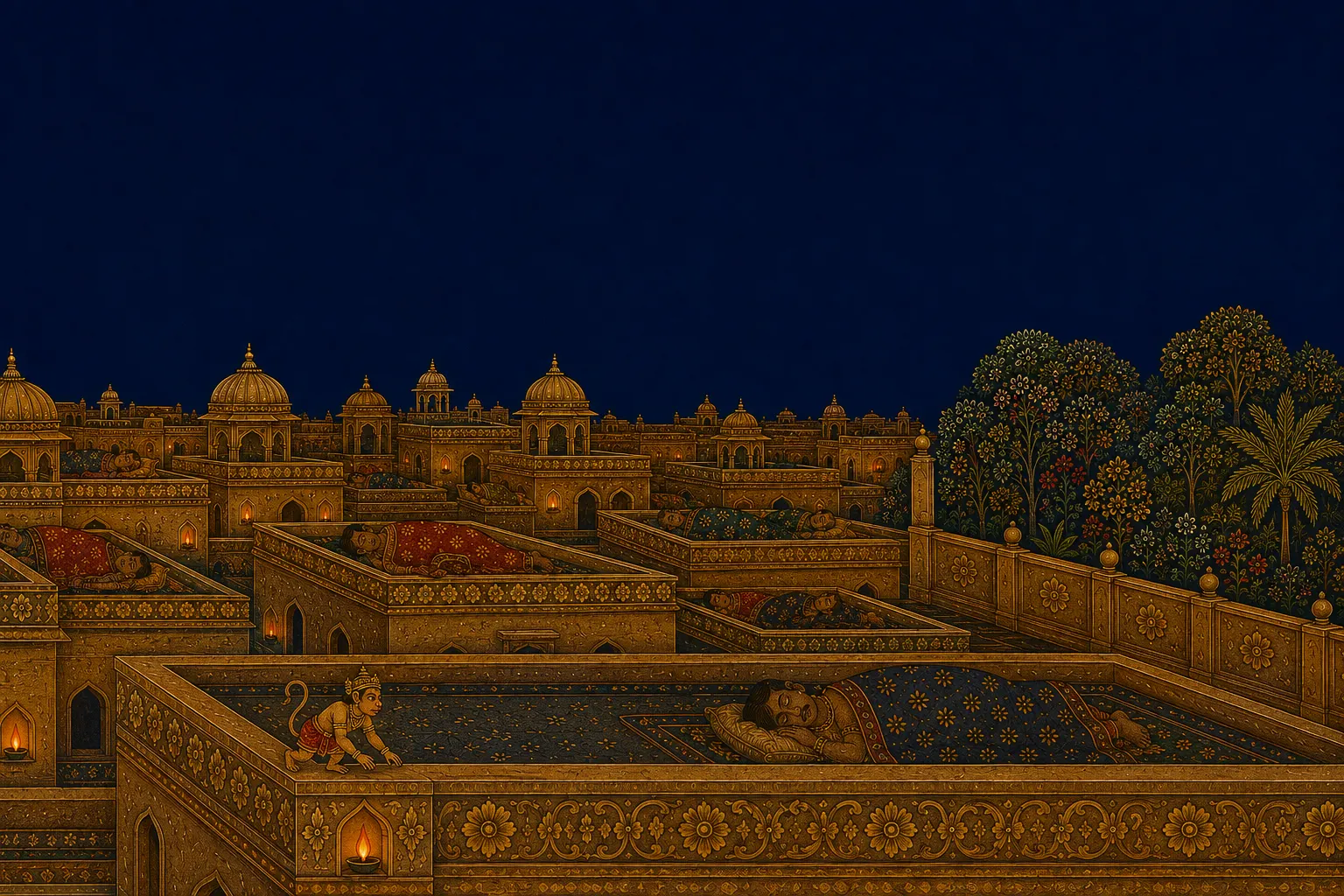
Inside, Lanka was asleep.
Walls of gold, lamps dying in the lanes, music somewhere far off that had stopped mid-phrase, the mixed smell of wine and flowers, and on the roofs, people asleep and unaware.
Hanuman went from roof to roof — small enough not to break anyone's sleep.
It looked like the safest place in the world. And somewhere inside it a woman was a prisoner.
Inside the palaces, and a doubt
He went palace by palace.
And here his largest difficulty came up: he did not know Sita by sight. He had never seen her. He had only two things — the description Rama had given him, and the jewellery that had fallen out of the sky when Ravana was carrying her off.
So he had to look everywhere — every chamber, every courtyard, every place where anyone might be.
And then a thought came that shook him through.
*I am going into other people's houses, uninvited, right inside. Am I committing a sin?*
He stopped. Then he argued it out with himself: *A man looking for someone lost has to look where people are. My mind has not wandered anywhere, and there is no fault in my intent. So where is the sin?*
He went on.
When everywhere had been looked at
The night began to thin.
The palaces looked at, the gardens looked at, the cellars, the chariot-houses, the sacrificial halls — all of it looked at.
Sita was nowhere.
Hanuman sat down on a wall, and for the first time the thing rose in him that had not risen so far.
*What if she is dead? What if she was dropped into the sea on the way? If I go back empty-handed, Rama will not live. And Lakshmana, and Bharata, and the whole army…*
*Then let me not go back at all. Let me sit here, go into the forest, or give up my life.*
And then, sitting in that same dark, he answered himself:
*No. There is no enemy greater than despair. A man who gives way to it makes even the work he has done worthless. As long as one place is left, this is not a defeat.*
One place that was left
He ran his eye over the whole city again from above.
There was one part he had not been to — a garden spread out beyond the wall, full of trees, set apart from the palaces.
The ashoka grove.
Hanuman got up and went that way.
Note: This whole chapter is from the Valmiki Ramayana's Sundara Kanda. The clash with the guardian of Lanka at the gate, the left-handed blow, and Brahma's condition that defeat by a vanara is the sign of the demons' end — all of it is recorded there. Hanuman's dharma-doubt with himself while searching, and his despair when the search failed and his coming out of it, are also Valmiki's own and not added by any later tradition. In the Ramayana this part goes by quickly, because there the question is what happened in Lanka; here the question is what that night did to a man on his own.
Source: from several texts, Lanka at night