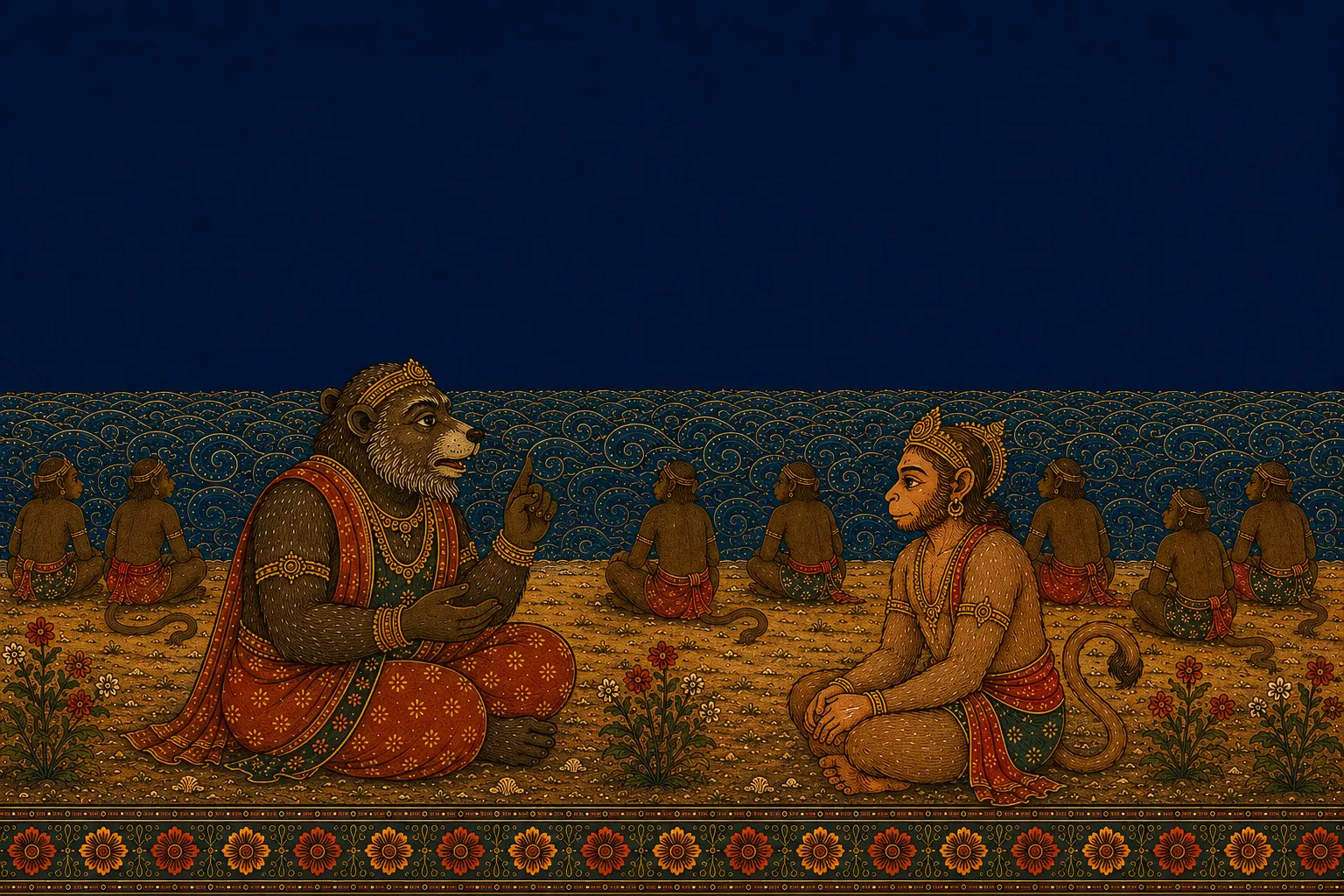
Chapter 2

Meeting Rama, and Jambavan

A man sent out to spy came back belonging to somebody else

Two strangers, seen from Rishyamuka

Sugriva was hiding on Rishyamuka, because Vali could not come there. Down in the forest two men appeared — tall, carrying bows, dressed in bark.

Sugriva's hand began to shake. "Vali has sent them. They have come to kill me."

"Or not," said Hanuman.

"Then go and find out. But do not go in a way that lets them see you are my man."

Hanuman started down. If those two really did turn out to be Vali's, nobody was coming back.

A brahmin who spoke very well

He came before them in a mendicant's guise and opened the conversation — soft, courteous, not one word out of place.

Rama listened a while. Then he looked at Lakshmana and said quietly:

"A man who speaks like that has read the Rig Veda, known the Yajur Veda, learned the Sama Veda by heart. He spoke that long and not one fault of grammar. And look — nothing on his face, nothing in his eyes, nothing in his brow. Nothing anywhere that looks hidden."

The disguise had not worked. But the reason it had not was no insult.

Rama had recognised the man in a single conversation.

Two men on his shoulders

Hanuman took off the disguise and told them the truth — who he was, who had sent him, and why.

Then he sat both brothers on his shoulders and carried them up to the top of Rishyamuka. Sugriva stood waiting above. That same day, with fire as witness, Rama and Sugriva became friends.

The man who had been sent out to spy that morning belonged to somebody else by evening.

Then a great deal of time went by

Vali was killed. Sugriva became king. The rains came and passed, and Sugriva's promise nearly passed with them — until Lakshmana came and reminded him.

Then the vanaras were sent out in the four directions. The southern party was Hanuman, Angada and Jambavan.

A month went by. Nothing was found. Going back was death too — Sugriva had settled that for anyone who did not return in time. Then they met Sampati, who told them Sita was in Lanka, across the sea.

On the shore everyone went quiet

They came and stood on the shore. A hundred yojanas of water, and Lanka beyond it.

Angada asked, "Who will go?"

One by one the vanaras spoke. One said ten yojanas, one twenty, one thirty. Even the highest number did not reach the far side.

Angada said, "I might get there. But I could not come back."

Jambavan shook his head. "You do not send the heir. And I am old — I could have crossed once, not now."

Then silence. Hanuman was sitting a little apart, quiet, as though none of it concerned him.

Jambavan turned to him

"Why are you silent?" said Jambavan.

Hanuman shrugged.

Then Jambavan came and sat beside him and began telling him his own story — who Anjana was, what Vayu had promised, how that child had reached the sun, where Indra's thunderbolt had struck, and what Brahma had said.

Hanuman listened to it as though it were somebody else's.

"This is you," said Jambavan. "You simply do not remember."

And then something moved. Hanuman stood, and as he stood he began to grow — the vanaras stepped back to make room, stones shifted, and the sand of the shore pressed down under his feet.

The condition of the curse had been met. Somebody had reminded him.

Note: Rama's judgement of Hanuman's speech — the Rig, Yajur and Sama Vedas, and not one fault of grammar — is in the Valmiki Ramayana at Kishkindha Kanda, sarga 3. Jambavan telling Hanuman his own story on the shore is in sarga 66 of the same kanda. But the explanation of a "curse of forgetting" is not there — it comes from the Uttara Kanda and later tradition, and many modern scholars hold the Uttara Kanda to be a later addition. So the being reminded is Valmiki's; the reason for the forgetting is tradition's.

Source: from several texts, Meeting Rama, and Jambavan

Now — how much stayed with you?

Why is that?

Why did Hanuman go to Rama and Lakshmana in a brahmin's disguise?

  • Because he wanted to hide his strength
  • Because Sugriva feared they had been sent by Vali, and being recognised could have cost Hanuman his life
  • Because begging alms was easier in a brahmin's guise
  • Because Rama had set that condition beforehand
Read the whole story — A dangerous errand

Sugriva lived on Rishyamuka precisely because Vali could not come there — the fear was real, not imagined.

The task Hanuman was given was no small one: go down, find out, and if they turn out to be enemies, face them alone.

Which is why this meeting matters so much — it did not begin in devotion. It began in suspicion.

Who said it?

"He spoke that long and not one fault of grammar." — who said this, hearing Hanuman speak?

  • Rama, to Lakshmana
  • Sugriva
  • Jambavan
  • Lakshmana, to Rama
Read the whole story — A disguise undone by learning

In the third sarga of the Kishkindha Kanda, Rama tells Lakshmana that a man who speaks like this must have read the Rig Veda, known the Yajur Veda and learned the Sama Veda by heart.

He also says that even speaking at that length there was no fault of grammar, and that in the mouth, the eyes, the brow — nothing anywhere looks hidden.

So Hanuman's disguise was undone not by his weakness but by his learning. It is his least-remembered quality in the whole gatha — he is a scholar first and strong afterwards.

Fact

Hearing Hanuman speak, which Vedas did Rama judge he had read?

  • Only the Rig Veda
  • All four, by name
  • No Veda, only grammar
  • The Rig, Yajur and Sama Vedas
Read the whole story — Recognised by his speech

The whole judgement was made from hearing him talk — Hanuman had not so much as mentioned his learning.

In tradition Hanuman is called a master of nine grammars, and the root of that is this episode.

Worth noticing: Rama said not one word about his strength. What showed of Hanuman at the first meeting was not force but language.

Who am I?

I am king of the bears. On that shore I defeated nobody in a fight — I only told a story, and it turned out to be the largest thing done that day. Who am I?

  • Sugriva
  • Angada
  • Jambavan
  • Sampati
Read the whole story — The one who did nothing but tell

In sarga 66 of the Kishkindha Kanda, Jambavan recites to Hanuman his birth, Vayu's promise, the leap at the sun, Indra's thunderbolt and the boons — all of it, one thing at a time.

It is the quietest scene in the whole gatha, and the largest. No weapon was used, no mountain lifted — an old man simply handed a young one his own name back.

Which is why this chapter is the axis of this gatha: the work immediately before Hanuman's greatest leap was somebody else's.

What happened?

When it was asked on the shore who could cross a hundred yojanas, what happened?

  • All the vanaras named Hanuman at once
  • Each vanara gave his own limit, and nobody's limit reached the far side
  • They all volunteered at once
  • Jambavan stood up to go himself
Read the whole story — A count that got nowhere

This scene matters because it shows the failure was real — it was not a performance in which everyone knew Hanuman would manage it.

Nobody knew. Hanuman did not know either.

Angada could go but could not return — and you do not send the heir on such an errand. The road was shut on every side.

Why is that?

Why was Angada refused for the crossing?

  • Because he was Vali's son and not trusted
  • Because he could not cross a hundred yojanas
  • Because Jambavan wanted to go himself
  • Because he could go but could not return, and you do not send the heir on such an errand
Read the whole story — The problem of being the heir

Angada said honestly himself that he would reach the far side but would have no strength left for the return.

A messenger's work is not only arriving — it is bringing news back. Even if a one-way journey found Sita, who would carry it to Rama?

That difficulty is the real reason for the silence in which Jambavan had to turn towards Hanuman.

Riddle

I had everything that was needed that day. Even so I sat silent on the shore — not because I was afraid, but because I did not know my own strength. Who am I?

  • Hanuman
  • Angada
  • Sugriva
  • Nala
Read the whole story — The real reason for the silence

This is the strangest thing in the gatha: of all the vanaras standing on that shore, the one who could do the most said the least.

That is the difference between fear and forgetting. A frightened man knows what he can do and still holds back; Hanuman did not know there was anything to hold back from.

Which is why the greatest service in this gatha is done not in a fight but in the telling of a story.

Valmiki or tradition?

"Hanuman had forgotten his strength and Jambavan reminded him" — where does this come from?

  • It is entirely later folk tradition, nothing in Valmiki
  • It is only in Tulsidas's Ramcharitmanas
  • The reminding scene is in Valmiki's Kishkindha Kanda; the sages' curse behind the forgetting comes from the Uttara Kanda and later tradition
  • Both are in the same place in the Uttara Kanda
Read the whole story — One story, two layers

In Kishkindha Kanda sarga 66, Jambavan tells Hanuman his own story — that part is Valmiki's own, and there is no doubt about it.

But "the sages cursed him to remember only when reminded" — that explanation comes from the Uttara Kanda and later tradition, and many modern scholars hold the Uttara Kanda to be a later addition.

Both are kept in this gatha, but with separate labels — the same method used in the Krishna-Leela.

Whose son?

On the shore Jambavan reminded Hanuman who his father was. Whose name was given?

  • Indra's
  • Vayu's
  • Surya's
  • Brahma's
Read the whole story — A father's name, the key to a strength

Jambavan's whole telling rested on one thing: you are the son of Vayu, and as far as Vayu can go, so can you.

Which is why the reminding worked — it was not praise, it was a reminder of lineage.

Crossing the sea afterwards, Hanuman's speed is measured against the wind again and again, and the root of that is this moment.

Put it in order

Which is the right order of these events?

  • Sampati's news → meeting Rama → Vali's killing → Jambavan's reminding
  • Meeting Rama → Sampati's news → Vali's killing → the shore
  • Meeting Rama → the friendship → Vali's killing → the vanaras' search → Sampati's news → the shore → Jambavan's reminding
  • Jambavan's reminding → meeting Rama → the friendship → Vali's killing
Read the whole story — From one meeting to one leap

Time passes very fast in this chapter — a meeting, a friendship, a war, a monsoon, and then months of searching.

But the whole chapter is really stretched between two scenes: one where nobody knows Hanuman, and one where Hanuman does not know himself.

Both times the recognition comes from outside — the first time Rama says who this is, the second time Jambavan says what he can do.