Chapter 3

The sea

A hundred yojanas of water, and three times somebody blocked the way — each time for a different reason

Mount Mahendra sank underfoot

Hanuman climbed Mount Mahendra and set his feet. The mountain began to press down under him — flowers shook from the trees, deer bolted, animals asleep in the caves came scrambling out, and springs of water burst from the rocks.

He drew a breath, raised his arms, and looked up at the sky.

"I will get there," he said, "and if Sita is not there, I will tear up Lanka and bring it back with me."

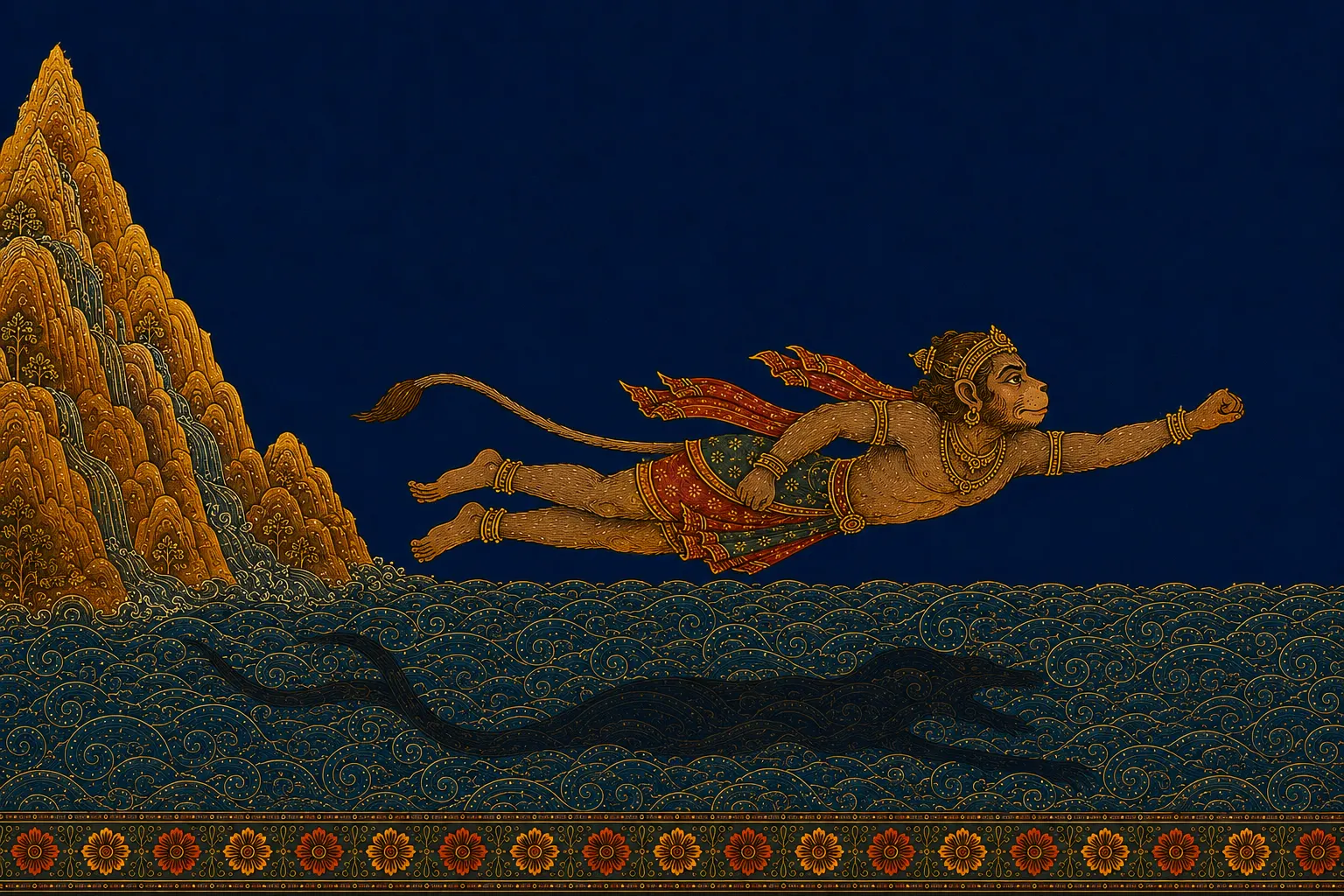
Then he leapt. The whole mountain shook behind him, and trees came up by the roots and flew along with him some distance through the air.

A mountain of gold, which rose to offer rest

In the middle of the sea the water stirred and a golden mountain rose up — Mainaka.

Hanuman took it for something blocking the way. But a voice came from the mountain:

"I have not come to stop you. Long ago, when Indra cut the wings off the mountains, your father Vayu lifted me and hid me in this sea. That debt is on me still. Sit, rest a while."

Hanuman touched the mountain with his hand — that was his thanks.

"The work is not finished," he said. "Until it is, I have no right to rest."

And he went on.

Surasa's mouth

Then a vast figure rose out of the water — Surasa, mother of the nagas. The gods had sent her, not to stop him but to test him.

"I have a boon that whoever passes this way becomes my food," she said. "Come into my mouth."

Hanuman first asked her to let him by. Then, when that did not work, he began to grow — ten yojanas, twenty, thirty. Surasa's mouth grew exactly as much.

Then Hanuman stopped. And all at once shrank to the size of a thumb, went into that mouth with the speed of lightning, and came out the other side.

"The boon is satisfied," he said. "I went into your mouth, and I have come out of it."

Surasa laughed and returned to her own form. "Go. The work you have been given will be done."

The one who caught shadows

Further on something odd began. Hanuman was flying, but every so often it was as though something were dragging him back — his speed broke, his body lurched.

He looked down. In the sea was Simhika, who caught the shadow of anything flying and dragged it down, and then ate it.

Hanuman did exactly what nobody else would do — he let himself be dragged, went into her mouth, and tore his way out from inside.

Then he flew on without stopping.

Far off, a burning city

At last something shone on the horizon. Mount Trikuta, and on its peak Lanka — walls of gold, lamps burning, and light spread all the way down.

Hanuman came down onto a tree and watched, holding his breath. This was not a place anyone could slip into quietly.

There was still time before nightfall.

Note: Mainaka, Surasa and Simhika are all three in the Valmiki Ramayana's Sundara Kanda, and all three have different purposes: Mainaka rises out of gratitude to offer rest, Surasa is sent by the gods as a test, and only Simhika is a real hunter. The story of the mountains' wings being cut is the background to this episode, coming from old story tradition. In the Ramayana this whole crossing comes as a messenger's journey; here it is the journey of a man who, a few hours earlier, did not know his own strength.

Source: from several texts, The sea

Now — how much stayed with you?

Why is that?

Why did Mount Mainaka rise up in Hanuman's way?

  • To stop Hanuman, because it was Ravana's ally
  • Because Vayu had saved it from Indra long ago, and it came to offer rest in repayment
  • Because the sea sent it to test Hanuman
  • Because it wanted to measure Hanuman's course
Read the whole story — An old debt

Tradition says the mountains once had wings and used to fly. Indra cut their wings off, but Vayu lifted Mainaka and hid it in the sea.

Which is why Mainaka counted itself in debt to Vayu's son — and when that son passed overhead, the mountain did what a debtor does.

It is the gentlest moment in the whole chapter: three things met him on the way, and one of them turned out to be a friend.

Fact

How did Hanuman get past Surasa's boon?

  • He fought Surasa and beat her
  • He flew around her and found a way past
  • He shrank to the size of a thumb, went into her mouth and came straight out
  • He called the gods and had the boon revoked
Read the whole story — Not strength but wit

Hanuman grew larger and Surasa's mouth grew exactly as much — so this road never opens in a contest of strength.

Then he did the reverse: he shrank. The boon said whoever passes must go into the mouth — he did precisely that, satisfied the condition, and came out.

It is the first real use of the learning Rama praised at their first meeting. Hanuman's largest victory at sea came from intelligence, not force.

Who am I?

I lived in the sea and caught the shadows of those flying over. When the shadow was pulled, the body came down of itself. Who am I?

  • Simhika
  • Surasa
  • Lankini
  • Trijata
Read the whole story — Hunting by shadow

Simhika is called chhayagrahini — the one who seizes shadows. The prey never learns why it is falling.

Hanuman first worked out what was happening — why his speed was breaking — and only then could he deal with it.

Then he used the reverse of the Surasa method: there he escaped by getting smaller, here he killed by getting inside. Both times the way out was not around but through.

Who said it?

"The work is not finished. Until it is, I have no right to rest." — who said this, and to whom?

  • Surasa to Hanuman
  • Jambavan to Angada
  • Rama to Sugriva
  • Hanuman to Mainaka
Read the whole story — A refusal of rest

Mainaka's offer was sincere and the need for rest was real — a hundred yojanas, and he was not yet halfway.

Hanuman neither rejected the offer nor took it: he touched the mountain with his hand in thanks and went on.

This small scene opens the whole of Hanuman — a man who can forget his own strength never forgets his work.

Why is that?

Why did the gods send Surasa into Hanuman's way?

  • Because they did not want Hanuman to reach Lanka
  • Because they wanted to see whether Hanuman had intelligence as well as strength
  • Because Surasa had asked for it herself
  • Because Ravana had put pressure on the gods
Read the whole story — A test set on the road

Surasa's task was not to beat Hanuman — it was to check whether this vanara was really right for what was coming.

Which is why the test was not of strength. Strength had already shown itself in the Mainaka episode; here the question was how he thinks in difficulty.

At the end of the test Surasa laughs and gives a blessing — which is what tells you she was never an enemy.

What happened?

What happened to Mount Mahendra when he leapt?

  • It broke and fell into the sea
  • Nothing happened to it
  • It sank under his feet, flowers shook from the trees, animals bolted and springs burst open
  • It rose into the air with Hanuman
Read the whole story — The cost of a leap

The story lingers on this scene, and the reason is plain: this is how you measure the strength Hanuman has only just got back.

Trees torn up by the roots, flying along a distance and then falling into the sea — that detail tells you how fast the leap was.

A man who had been sitting silent on the shore a few hours earlier pressed a mountain down the moment he stood. That is the difference between forgetting and remembering.

Riddle

I am not a body, but I go with the body. In the sea somebody caught me and dragged my owner down. What am I?

  • A shadow
  • Breath
  • A voice
  • A tail
Read the whole story — Hunting by shadow

This method is frightening in the story precisely because the attack is not visible — the prey only feels that it is falling for some reason.

Hanuman's victory here is one of understanding before force: he first recognised where the pull was coming from.

All three obstacles were of different kinds — one gratitude, one a test, and one a real hunter. The way through came differently all three times.

Valmiki or tradition?

"Mountains once had wings and Indra cut them off" — where does this come from?

  • It is the main narrative of the Valmiki Ramayana
  • It is entirely a modern invention
  • It is the background to the Mainaka episode, coming from old story tradition
  • It is a story Tulsidas added
Read the whole story — Mountains with wings

This is one of those stories that come inside the main story to give an old reason for something — Mainaka's behaviour makes no sense without it.

The method shows up again and again in Indian storytelling: a character does something strange, and then an older story explains why.

In this gatha every such background story is marked separately, so that the main story and the tradition behind it do not run together.

Fact

How many times did anybody come into Hanuman's way while crossing the sea?

  • Once
  • Three times
  • Five times
  • Nobody came
Read the whole story — Three meetings, of three kinds

These three are often called "the three obstacles", and that is not right — only one of them was actually an obstacle.

Mainaka came to help, Surasa came to test, and Simhika really did come to eat.

Which is why Hanuman's answer was different each time: gratitude, then wit, and force only at the end.

Why is that?

Why did Hanuman refuse Mainaka's offer of rest, when he was not yet halfway?

  • Because he did not trust Mainaka
  • Because he was not tired
  • Because the gods had forbidden it
  • Because for him rest meant nothing until the work was done
Read the whole story — A test at the halfway point

It is the least noisy moment of the chapter and the most telling.

Mainaka had asked for nothing wrong — the rest was fair, the offer sincere, and there was no penalty for refusing.

Which is why the refusal matters: nobody was watching it. A man who does not stop even without a witness is the one who is about to enter Lanka alone.