Chapter 6

Sanjeevani

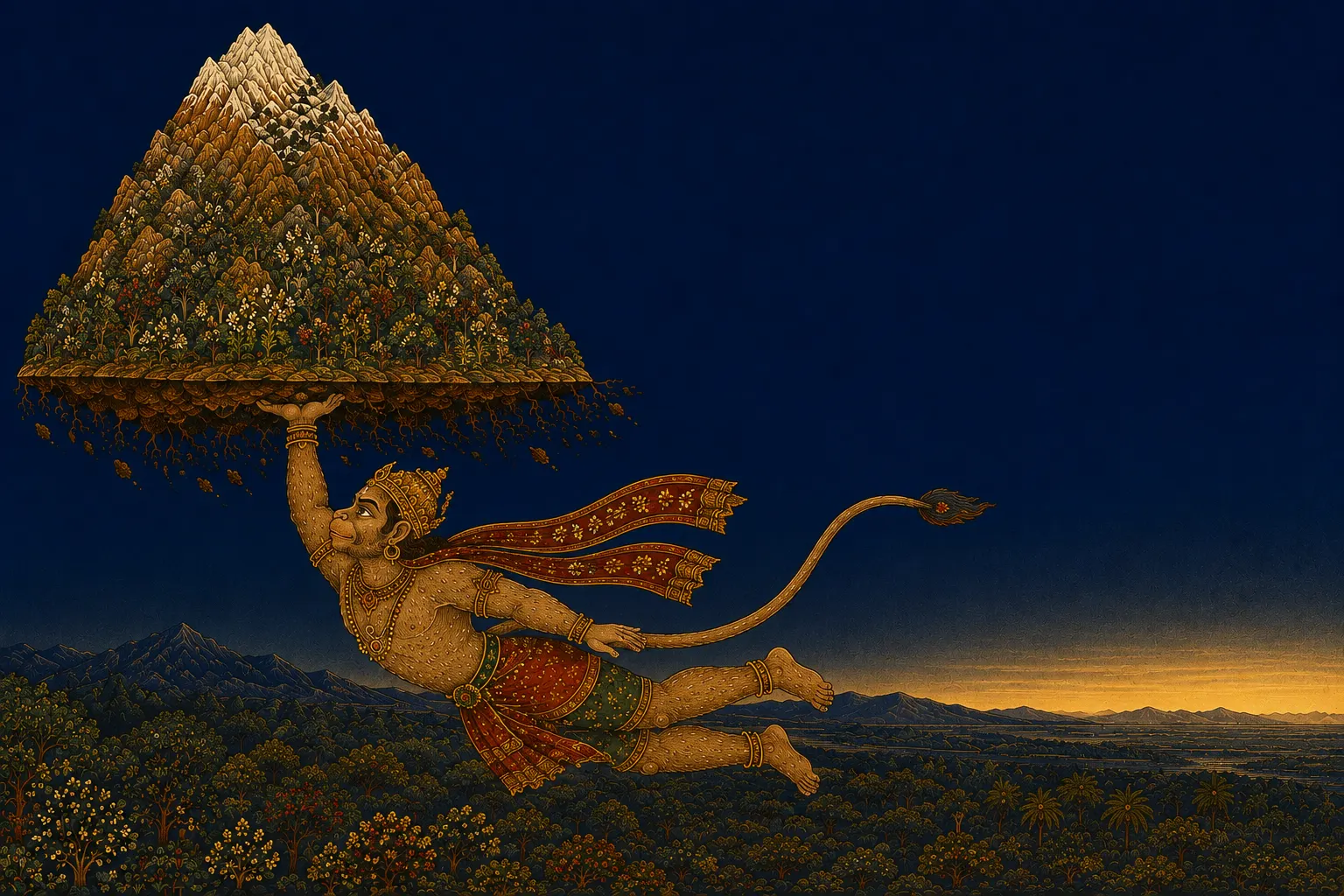
He could not tell the herbs apart, so he carried the whole mountain

Night, and a physician naming names

Lakshmana lay on the ground. He was breathing, but very faintly.

Rama sat beside him and was listening to nobody.

Then Sushena came forward — the physician of the vanaras.

"There are four herbs," he said. "Mritasanjeevani, vishalyakarani, suvarnakarani and sandhani. They grow on a mountain in the Himalaya."

Then he looked up at the sky.

"And they must be here before the sun comes up. After that nothing can be done."

Everyone went quiet. The Himalaya was very far. The night was very short.

Northward

Hanuman stood up.

He did not have to say anything, and nobody stopped him. He rose into the sky and turned north.

Below him the battlefield fell away — burning tents, wounded soldiers, and the ground where his young prince lay unconscious.

Then the plains ended, rivers came, and then snow.

The herb he could not tell

He came down on the mountain.

And there the thing happened that nobody had warned him about.

The whole slope was full of herbs — thousands of plants, all looking alike. Which was the mritasanjeevani, which the vishalyakarani, which something else — there was no telling.

He bent down and looked, picked up one plant, then another, then a third.

In the east the colour of the sky was starting to change.

*There is no time. And taking the wrong herb means Lakshmana does not live.*

Then the whole mountain

He put the plants down and stood up straight.

Then he began to grow — until the mountain was small in front of him.

He took the peak in both hands, put his weight into it, and pulled it up by the roots — earth, snow, trees, and all those herbs, together.

Then, carrying that peak, he leapt southward.

Coming back

Below, the battlefield of Lanka was waiting.

Hanuman came down and set the peak in front of Sushena.

"I could not tell the herb," he said. "So I have brought the whole peak. Look for yourself."

Sushena picked out from the plants what was needed, ground it, and held it near Lakshmana's nose.

Lakshmana drew a breath. Then opened his eyes. Then sat up — the dart had come out, the pain had gone.

Rama said nothing. He only looked at Hanuman.

And the mountain back

The work was done, but Hanuman did not sit down.

He lifted that same peak again and flew north, and put it back exactly where he had torn it from.

Nobody had asked him to do that.

Note: Sushena naming the four herbs — mritasanjeevani, vishalyakarani, suvarnakarani and sandhani — Hanuman being unable to identify them and so carrying the whole peak, and Sushena grinding the herb for Lakshmana to breathe: all of this is in the Valmiki Ramayana's Yuddha Kanda. Hanuman says himself that he could not identify the herb, which is why he brought the whole peak. The Kalanemi episode, in which a demon in an ascetic's guise blocks the road, is not found in this part of Valmiki — it comes from later texts and tradition.

Source: from several texts, Sanjeevani

Now — how much stayed with you?

Fact

Who named the herbs Lakshmana needed?

  • Jambavan
  • Sushena
  • Vibhishana
  • Sugriva
Read the whole story — A physician's work

Sushena did not only give the names — he also said where they would be found and how long there was.

That condition is what makes the whole episode so tight: the medicine exists, the place is known, and everything still rests on time.

And when Hanuman comes back with the whole peak, it is Sushena who does the identifying — which is to say neither of them could have done this alone.

Why is that?

Why did Hanuman carry the whole mountain peak instead of picking the herb?

  • Because he could not bend down to pick it
  • Because he wanted to show his strength
  • Because the mountain refused to give him the herb
  • Because there were thousands of identical plants on the slope and he could not tell them apart, and time was running out
Read the whole story — An honest solution

Hanuman did not hide it on his return. He said plainly that he could not tell the herb, and that is why he had brought the whole peak.

It is among the most practical decisions in this whole gatha: when you cannot tell and there is no time, do not choose — bring everything, and give the choosing to the one who knows.

Which is why this scene is about sense more than strength. Lifting the mountain was the easy part; admitting "I do not know" was the hard one.

Fact

How many herbs did Sushena name?

  • Four
  • Two
  • Three
  • Seven
Read the whole story — Four different tasks

The names show their work — one to bring back life, one to draw out a shalya, an embedded weapon, one to restore colour, and one to knit together.

So this was not one medicine but a whole treatment, and that is why all four had to be there.

The detail also explains why Hanuman's difficulty was so large: he had to identify not one plant but four separate ones.

What happened?

After the peak was brought back, how was Lakshmana treated?

  • A paste of the herb was put on the wound
  • Sushena ground the herb and had Lakshmana breathe it in
  • The herb was boiled in water and given to him to drink
  • The whole peak was set beside Lakshmana and he recovered by himself
Read the whole story — A treatment given by scent

Lakshmana was unconscious at the time, so nothing could be given to him to drink — the herb was ground and held for him to breathe.

The effect was immediate: the embedded dart came out, the pain went, and he sat up.

Worth noticing: Hanuman brought the mountain, but Sushena did the treating. The victory in this episode belongs to two people, not one.

Later tradition

"On the way a demon named Kalanemi took the guise of an ascetic and tried to stop Hanuman" — where does this story come from?

  • From the Valmiki Ramayana's Yuddha Kanda
  • From the Sundara Kanda
  • From the Kishkindha Kanda
  • From later texts and tradition
Read the whole story — Another obstacle set on the road

In the Kalanemi story Ravana sends a demon who takes an ascetic's guise and tries to stop and mislead Hanuman.

The story is found in later tradition and in some other Ramayanas, not in Valmiki's Sanjeevani episode — there Hanuman's real difficulty is no enemy at all but his inability to identify the herb.

Both stories run alongside each other in tradition. This gatha records both, saying which comes from where.

Why is that?

Why did Sushena set the condition of before sunrise?

  • Because the mountain cannot be seen by day
  • Because the herb only grows at night
  • Because after that Lakshmana could not be saved
  • Because Ravana was going to attack in the morning
Read the whole story — A race that lasts one night

The whole episode rests on that one condition — the medicine exists, the place is known, the man to fetch it is there, and everything still rests on time.

Which is why Hanuman could not take long over choosing the herb. The eastern sky was changing colour, and he had to decide there.

Lifting the mountain is the direct result of that limit. With time he might have gone on trying to identify it.

Who am I?

I am the physician of the vanaras. I lifted no mountain and fought no battle — but without me that mountain was useless. Who am I?

  • Sushena
  • Jambavan
  • Nala
  • Angada
Read the whole story — The one who could tell

Hanuman's strength was only of use in this episode once Sushena's knowledge was joined to it.

The one who could bring the mountain could not identify the herb; the one who could identify the herb could not reach the mountain.

This keeps returning in the gatha — even Hanuman's greatest work is never his alone. Jambavan reminded him, Sita cooled the fire, and here Sushena identified the herb.

What happened?

After Lakshmana recovered, what did Hanuman do with the mountain peak?

  • Left it there on the battlefield
  • Threw it into the sea
  • Lifted it again and put it back in the same place in the Himalaya
  • Handed it over to Sushena
Read the whole story — Work done without being asked

This small detail is what completes the whole chapter. The work was over, Lakshmana was up, and nobody cared about that mountain.

Hanuman got up anyway, carried it north, and put it back exactly where he had torn it from.

It is his least-discussed act in this gatha, and perhaps the one that describes him best — what has been taken is put back.

Riddle

I was torn up because somebody could not identify one thing inside me. Then I was put back, once that thing had been found. What am I?

  • The mountain peak with the herbs on it
  • The ashoka tree
  • Mount Mahendra
  • Mount Trikuta in Lanka
Read the whole story — A mountain's short journey

It may be the strangest journey in the whole tradition — a mountain went from the Himalaya to Lanka, stayed one night, and came back to its place.

The reason for lifting it was not strength but a lack of knowledge. Had Hanuman been able to tell, the mountain would have stayed where it was.

And there was no reason at all to put it back — except that it belonged there.

Why is that?

Why did it have to be Hanuman who went for this?

  • Because only he could identify the herbs
  • Because Rama had named him particularly
  • Because everyone else was wounded
  • Because going to the Himalaya that night and being back before sunrise was beyond anyone else
Read the whole story — The only one who could get there

This is the same strength he himself had not known about until a short while before — and now the hope of a whole army rested on it.

Worth noticing: he was not sent. He got up himself, and nobody stopped him.

That is the distance from the Jambavan scene to here: there he had to be reminded what he could do; here nobody had to say anything.